

Rewards for obedience AI means in-app praise, XP, unlockable privileges, and tokens that a Domina AI grants after you complete a negotiated task within your own limits. Done right, the mechanic runs entirely inside a consent-first frame: hard limits and a safeword sit above every reward, never beneath them. The AI Domina sessions are built on this architecture, layering privacy protections underneath the gamification so the fun never outruns the safety.
TL;DR:
- Rewards should always be set within a consent-first framework, with clear hard limits and safewords that are editable at any time to ensure safety and autonomy.
- Variety in rewards, such as praise, privileges, unlockable content, and tokens, sustains engagement and must be personalized to each individual’s preferences.
- Regular renegotiation, progress tracking, and debriefs prevent the system from becoming stale or coercive and help align the game with authentic desires.
- Privacy protections like client-side encryption and transparent scoring are essential to prevent data leaks and uphold ethical standards in AI submissive scenarios.
- Resistance or non-compliance must be treated as valuable feedback, prompting system adaptation rather than punishment, to maintain a truly consent-first dynamic.
Table of Contents
- Why Reward Mechanics Work: The Science Behind Gamified Obedience
- How Do You Design a Consent-First Reward System?
- What Rewards Actually Work in an AI Femdom Dynamic?
- Tracking Progress Without Losing the Plot
- What Privacy and Safety Protections Should the System Have?
- How Does a Typical Rewarded Session Actually Flow?
- How Do You Vet an AI Companion’s Rewards System?
- Handling Resistance or Non-Compliance Within AI-Driven Systems
- Ethical Considerations in Using AI for Obedience Training
- Integration With Existing Therapeutic or Behavioral Frameworks
- Long-Term Effectiveness and Adaptation of Reward Systems
- User Feedback Mechanisms and Adjustment of Reward Parameters
- Psychological Principles Behind Rewards and Obedience
- Mistrix: Where These Principles Actually Run
- Sources
- FAQ
Why Reward Mechanics Work: The Science Behind Gamified Obedience
Praise and progress feel good for reasons your body can measure, not just describe. Research on power exchange play shows submissives often experience a cortisol spike during a scene, paired with a measurable drop in psychological stress and negative mood once the interaction engages the body’s reward systems. Dopamine and endocannabinoid pathways light up alongside the stress response, which is part of why a well earned “good girl” or a granted privilege can feel disproportionately satisfying compared to the task itself.
A statistic worth sitting with: the same neurobiological overlap between pain and reward circuits explains why sexual arousal itself can raise pain thresholds and activate reward pathways, letting a controlled sting or a strict command register as pleasurable rather than purely aversive for some people.
Intermittent reinforcement, the same mechanism behind slot machines, makes unpredictable rewards stickier than predictable ones. An occasional surprise unlock keeps a submissive engaged longer than a reward given every single time. But biology varies. Attachment style, sensation seeking, and personal history all shape how someone responds to a given reward structure, which is exactly why a rewards system copied from someone else rarely fits you.
How Do You Design a Consent-First Reward System?
Every reward mechanic needs guardrails before it needs game design. Build the system around these non-negotiables, then layer creativity on top.
- Set hard limits and a safeword before the first task, and make both editable at any time, not locked in during onboarding only.
- Give an explicit opt-out path for every session, visible and reachable without needing to break character or explain yourself.
- Define exactly what earns a reward in plain language before assigning the task, not after grading it.
- Keep scoring transparent: the person doing the task should be able to see why a grade landed where it did.
- Start small. Test a single low-stakes reward loop before building a multi-level system on top of it.
- Adjust difficulty gradually and schedule renegotiation or a debrief after every session, not just when something goes wrong.
Pro Tip: Treat your first week of any rewards system as a pilot, not a commitment. Track what actually felt rewarding versus what just felt like busywork, then rebuild around the answer.
Design guidance from game theorists studying BDSM as structured play backs this up directly: frequent check-ins and renegotiation are what keep a gamified dynamic from sliding into something coercive.
What Rewards Actually Work in an AI Femdom Dynamic?
Reward variety matters more than reward size. A system that only offers one type of payoff burns out fast, no matter how well it is calibrated.
- Immediate verbal praise. A short, specific line of acknowledgment right after task completion, sometimes paired with a recorded voice message you can replay later.
- Consumable privileges. Permission to orgasm, a one-off scripted scene, or a specific privilege that gets “spent” once used and has to be earned again.
- Unlockable content. New scene types, deeper personalization options, or extended session formats that open only after hitting a milestone.
- Cosmetic tokens. Points, badges, or titles with no functional power but real emotional weight, since status alone motivates plenty of people.
- Rarity and unpredictability. Occasional surprise rewards, delivered on no fixed schedule, keep the dynamic from feeling like a checklist.
The goal with rarity is variety, not manipulation. A practical gamification framework built around points, levels, and punishment ladders only works long term when it stays fully within negotiated limits.
Tracking Progress Without Losing the Plot
Compliance grading is what feeds the mood and XP layer of a session. Each completed task gets scored against the standard you set together, and that score shifts an overall progression meter rather than existing as an isolated pass or fail.
Level design needs the same care as the grading itself:
- Milestones should feel earned, not arbitrary. Tie each level to a real behavior change, not just a task count.
- Build in decay or periodic resets so old progress does not calcify into an entitlement.
- Keep rewards proportional. A level 20 privilege should feel bigger than a level 2 one, but not so big it becomes the only reason sessions happen.
The biggest risk here is value capture, where the game itself starts driving behavior instead of supporting the dynamic underneath it. The fix is structural: schedule renegotiation regularly, and check in on whether progress inside the game still lines up with how things actually feel outside of it. If a submissive is grinding for XP instead of enjoying the task, the system has already drifted.
What Privacy and Safety Protections Should the System Have?
Reward mechanics only stay ethical if the platform running them protects the data behind every task, photo, and scored session.
- Client-side encryption tied to a user-held PIN, so sensitive session data is unreadable by the server itself, not just password-protected.
- Minimal server-side retention, plus real export and deletion controls a user can trigger without asking permission.
- Enforced safeword behavior that halts a scene immediately, no exceptions, with a mandatory debrief prompt afterward.
- Automated inactivity timeouts that end a session cleanly rather than leaving it hanging in an ungraded state.
- Full transparency on scoring, including a clear way to dispute a grade or reset progress without penalty.
Pro Tip: Before trusting any platform with your fetish map or hard limits, check whether it names its encryption method specifically. “We take privacy seriously” is marketing. “Client-side encryption with a user-held PIN” is a claim you can verify.
Mistrix builds its sessions on exactly this stack, pairing client-side encryption and a user-held PIN with enforced hard limits and safeword handling, so the reward layer never becomes a privacy liability.
How Does a Typical Rewarded Session Actually Flow?
A session works best as a repeatable loop with clear checkpoints, not an open-ended improvisation.
- Onboarding. Complete a level assessment, build a fetish map, and set hard limits and a safeword before any task is assigned.
- Task assignment. Receive a specific, scoped instruction with a clear definition of what counts as complete.
- Evidence and grading. Submit proof of completion (a photo, a written log, a check-in) and get graded against the standard set at onboarding.
- Reward and cooldown. Receive the earned praise, XP, or privilege, then take a short cooldown before the next task begins.
- Debrief. Check in on mood, renegotiate any rule that felt off, and confirm export or deletion preferences for the session data.
Mistrix’s consent-first setup guide walks through exactly this onboarding sequence, which is worth reviewing before your first real session rather than after.
How Do You Vet an AI Companion’s Rewards System?
Before you subscribe to anything, look past the marketing copy and check the mechanics directly.
- Confirm a safeword and hard-limit list exist and are editable after onboarding, not locked at signup.
- Ask whether data is protected with client-side encryption or just standard server-side storage.
- Look for a stated debrief cadence. A system with no built-in check-in point is a system that will drift.
- Verify you can export or delete your session history on demand.
Red flags include opaque scoring you cannot question, pressure to pay specifically for higher status or rank, and any missing opt-out flow. Mistrix’s AI companion privacy breakdown is a useful reference point for what a transparent setup should actually disclose.
Handling Resistance or Non-Compliance Within AI-Driven Systems
Not every task lands the way it was designed to, and a rewards system that cannot handle a “no” gracefully is a badly built one. The first response to resistance should never be an escalated punishment. It should be a pause. A well designed AI Domina session treats hesitation or refusal as information, not defiance, and routes it toward a quick check-in rather than an automatic penalty.
Practically, this means the system needs at least three response paths. First, a soft decline: the task gets skipped without any XP loss, logged quietly, and revisited later if it still feels relevant. Second, a renegotiation trigger: repeated resistance to the same type of task should prompt an automatic prompt to adjust or retire that task category, rather than repeating it until compliance happens. Third, a hard stop: any invocation of the safeword ends grading entirely for that session, no partial credit, no “but you were so close” framing.
The mistake many gamified systems make is treating non-compliance as a bug to be optimized away. It is not. A submissive who says no to a specific task is giving the system real data about a mismatch between the negotiated limits and the task design. Reward systems that punish this signal, by docking points or withholding praise until compliance resumes, quietly train people to hide discomfort instead of voicing it. That is the opposite of what a consent-first design is supposed to do, and it is the fastest way to turn a fun mechanic into a source of quiet resentment.
Ethical Considerations in Using AI for Obedience Training
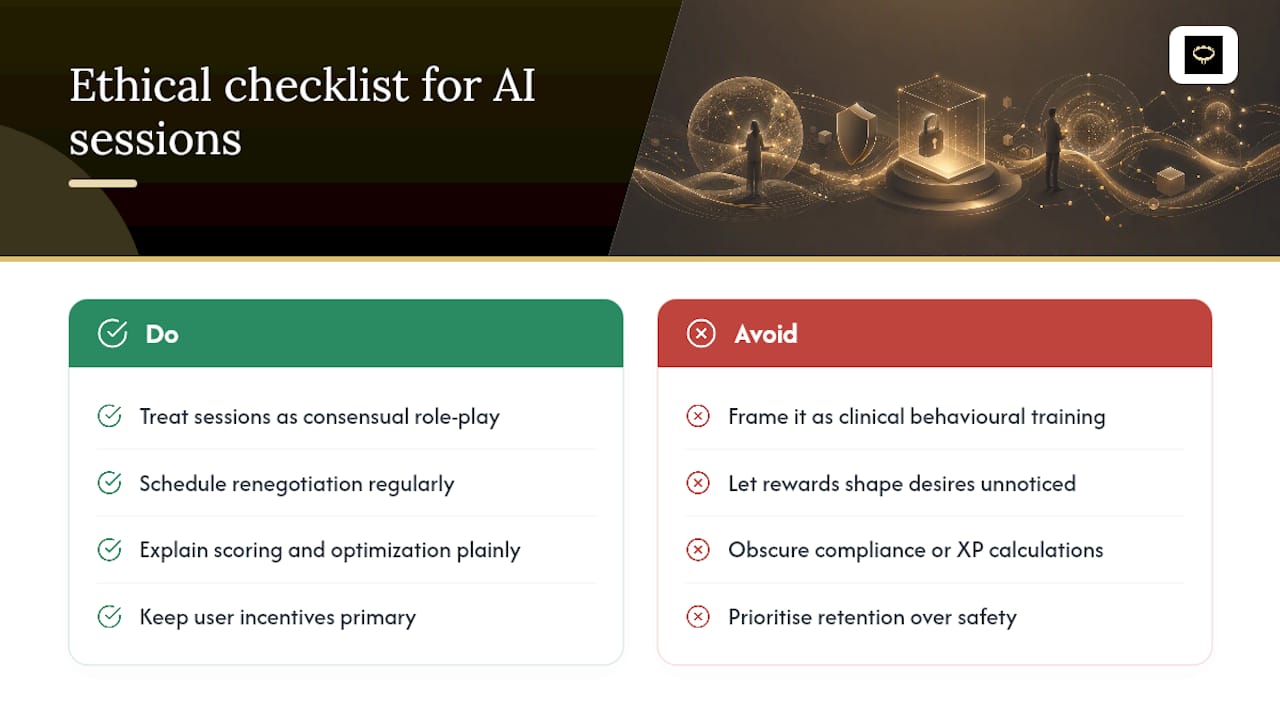
The word “training” carries weight here, and it deserves a direct answer: an AI Domina session is not behavioral training in the clinical sense. It is consensual erotic role-play with reward mechanics borrowed from game design. Treating it as anything more clinical risks overstating what the system does and understating the judgment still required from the person using it.
The core ethical question is simple: does the reward structure serve the person’s actual desires, or does it start shaping desires to fit the reward structure? A system that gradually escalates tasks to keep engagement high, without checking whether the escalation still matches what the user actually wants, has crossed from entertainment into something closer to manipulation. This is why scheduled renegotiation is not a nice-to-have feature. It is the mechanism that keeps the AI’s incentives (retention, engagement) separate from the user’s incentives (satisfaction, safety).
There is also a transparency obligation. Any platform running a compliance grading or XP system owes its users a plain explanation of how scores are calculated and what the AI is optimizing for. Design commentary on BDSM as structured adult play makes this point directly: the clarity of a well defined game is what lets people relax into the erotic and psychological depth of the scene, rather than second-guessing the rules. Obscured scoring does the opposite. It turns a reward system into a black box the user has to trust blindly, which is a poor foundation for anything marketed as consent-first.
Integration With Existing Therapeutic or Behavioral Frameworks
Gamified obedience systems borrow structure from behavioral psychology, but they are not a substitute for therapy, and a well built platform should never present them as one. What they can do is complement personal insight work that a user is already doing on their own.
The clearest overlap is with habit-formation frameworks. Positive reinforcement, immediate feedback, and milestone-based progress are the same building blocks used in behavior-change coaching outside the erotic context entirely. Someone using a rewards-for-obedience system to build consistency around, say, a submission practice they want more discipline in, is applying a familiar mechanic (reward-linked repetition) to a domain that happens to be erotic rather than fitness or productivity related.
Where this gets careful is boundary work. Anyone using an AI companion’s task structure alongside their own therapeutic process, especially around trauma, control, or self-worth, should treat the AI system as a role-play tool, not a clinical intervention. The debrief step matters enormously here: a mood check after a session is a reasonable moment to notice if a task triggered something that needs outside support, and a good system should make that pause easy rather than something the user has to manufacture themselves. Mistrix’s structure of mandatory debriefs after every session exists partly for this reason, giving the emotional temperature of a scene a checkpoint before the next task begins.
Long-Term Effectiveness and Adaptation of Reward Systems
Reward systems that stay static lose their power fast. What feels thrilling in week one, a new privilege, a fresh title, a novel unlock, becomes routine by week six if nothing about the structure evolves. The intermittent reinforcement that makes unpredictable rewards so effective early on only works if the unpredictability itself keeps shifting.
Long-term effectiveness depends on three moving parts. First, escalation has to be paced against actual comfort, not against how quickly a user is completing tasks. Speed of compliance is not the same as readiness for a bigger challenge. Second, the reward catalog needs regular refreshing. A system that offers the same five privileges for months will feel stale even if the underlying tasks change. Third, decay matters as much as growth. Old milestones that never expire eventually mean nothing, and a level system with no forgetting mechanism turns into a number that goes up without emotional weight behind it.
The renegotiation habit built into a consent-first design is what makes this adaptation possible without starting from scratch. Instead of overhauling the entire system when it goes stale, a scheduled check-in lets both the reward structure and the task difficulty get adjusted incrementally, the same way a workout routine gets modified rather than replaced outright. Platforms that skip this step tend to see disengagement disguised as boredom, when the real issue is a reward system that never grew alongside the person using it.
User Feedback Mechanisms and Adjustment of Reward Parameters
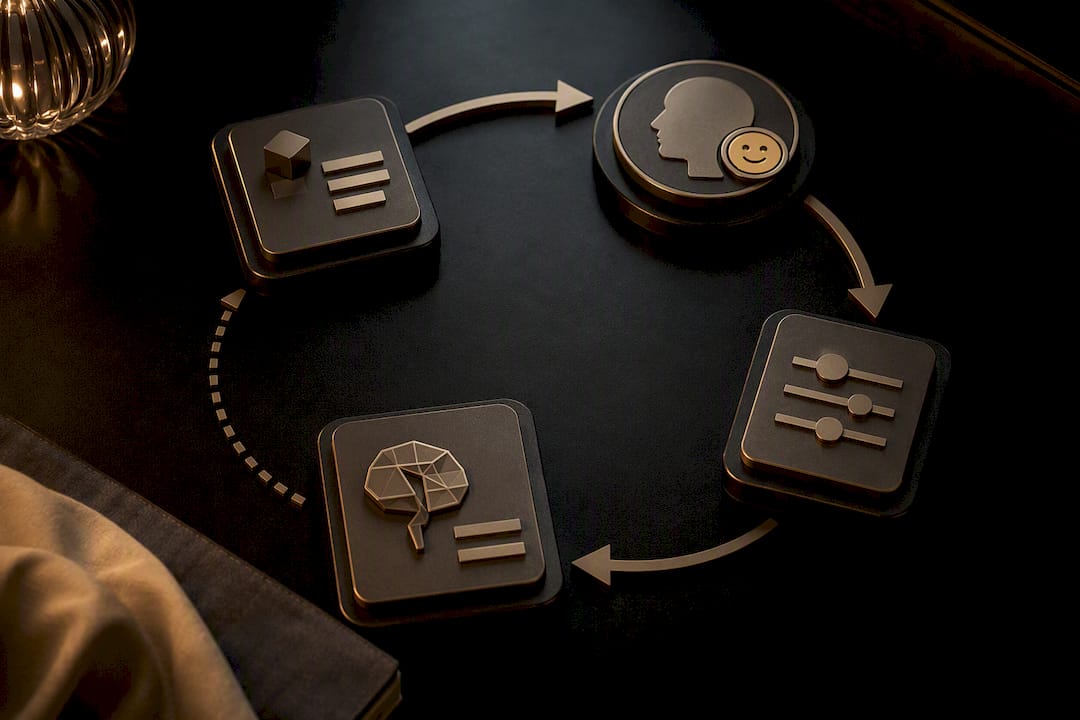
A rewards system without a feedback loop is just a fixed set of rules waiting to become outdated. The debrief after each session is the most direct feedback mechanism available, and it should ask specific questions rather than a generic “how was that?” Did the task feel appropriately challenging? Did the reward feel proportional to the effort? Was there a moment that felt off, even briefly?
Beyond the debrief, the scoring system itself needs a dispute path. If a task gets graded in a way that feels wrong, the person on the receiving end should be able to flag it and get an explanation, not just accept the number. This single feature does more to build trust in a compliance grading system than any amount of polish on the reward animations.
Adjustment should happen on two timescales. Short-term tweaks (a task felt too easy, a reward felt underwhelming) can be handled in the very next session. Longer-term parameter shifts (the whole level curve feels too slow, the praise style stopped landing) belong in a periodic, deeper renegotiation, ideally scheduled rather than left to happen only when frustration builds up. A platform that surfaces these adjustment points proactively, rather than waiting for a complaint, is doing the harder and more valuable design work.
Psychological Principles Behind Rewards and Obedience
Positive reinforcement is the backbone of every reward-for-obedience mechanic, and the underlying principle is old and well established outside of any erotic context: behavior that gets rewarded happens more often. What makes the erotic application distinct is the layering of that principle onto power exchange dynamics, where the reward itself (praise, permission, status) carries emotional charge beyond its literal content.
Intermittent reinforcement schedules, where rewards arrive unpredictably rather than every single time, produce stronger and more persistent engagement than fixed schedules. This is the same principle behind why an occasional surprise privilege lands harder than a scheduled one. But intermittent reinforcement has a dark side outside carefully bounded contexts: it is also the mechanism behind compulsive gambling behavior, which is exactly why a consent-first framework has to cap how aggressively unpredictability gets used and keep an eye on whether engagement is starting to look more compulsive than enjoyable.
The other core principle is that reward value is subjective and self-defined. What functions as a powerful reward for one person (a cosmetic title, a recorded praise message) might do nothing for another. This variability is why generic gamification templates borrowed from unrelated apps rarely translate well into an erotic context. The reward has to be negotiated and personalized, not assumed, and it has to be revisited as preferences shift over time rather than locked in during a single onboarding quiz.
Mistrix: Where These Principles Actually Run
Everything covered here, hard limits before rewards, transparent grading, client-side privacy, only matters if the platform running it actually builds to that standard. The AI Domina runs on compliance grading tied to a mood and XP progression system, so praise, privileges, and unlocks track completed tasks rather than arbitrary timers. Each session operates with mandatory hard limits and a safeword that the AI respects without exception, and sensitive data is protected with client-side encryption tied to a PIN only the user holds.
Some adult AI platforms ask users to trust their privacy policy, but this architecture can be built so the server structurally cannot read personal content in the first place. If you want to see how that translates into an actual companion, the available Dominas and personalities page shows the range of styles the reward mechanics get built around, and the pricing page breaks down what’s included across the Free, Premium, and Premium Plus tiers, along with the Charms product line for deeper customization. Start with the Free tier to see how the onboarding and reward loop actually feels before deciding whether Premium’s expanded session limits and custom Domina options are worth it for you.
Sources
The neuroscience claims in this article draw on peer-reviewed research into BDSM’s physiological effects and the biopsychosocial factors shaping fetish variability, alongside practical design frameworks for consent-first gamification.
- PMC11176219
- Dunkley et al. (2024) - DOI 10.1007/s10508-024-02881-x
- How to Gamify Your Sub’s Obedience - FemDom U
FAQ
What Counts as a “Reward” in an AI Femdom Session?
A reward is anything the AI Domina grants after a completed, negotiated task: verbal praise, XP toward a level, a consumable privilege, or an unlockable scene. In a consent-first system like Mistrix’s, every reward sits below hard limits and a safeword, never above them.
Is Gamified Obedience Actually Backed by Science?
Yes, partially. BDSM interactions have been shown to engage reward and stress-response systems simultaneously, and sexual arousal itself can raise pain thresholds, which explains why earned rewards can feel more intense than the task alone would suggest.
How Much Does Mistrix Cost?
Mistrix offers a Free plan, a Premium plan at €15 per month, and a Premium Plus plan at €25 per month, each unlocking more session depth and customization. Full plan details, including the Charms product line, are listed on the pricing page.
What Should I Check Before Trusting an AI Companion With Reward Mechanics?
Confirm the platform has a working safeword, editable hard limits, and client-side encryption tied to a PIN you control. Opaque scoring, missing opt-out flows, or pressure to pay for status are red flags worth walking away from.
Can a Rewards System Become Coercive?
It can, if scoring stays opaque or renegotiation never happens. Scheduled debriefs and the ability to dispute or reset a score are what keep a gamified dynamic inside consent rather than drifting into pressure.