
A level assessment quiz maps your experience, role preferences, hard limits, and safeword before your first scene, so every session an AI Domina builds actually fits you instead of guessing. Done right, it protects consent as a structural rule, not a suggestion, and it keeps sensitive answers locked down through encryption you control. Such platforms use this model to turn a one-time questionnaire into an ongoing, personalized relationship.
TL;DR:
- The assessment quiz measures multiple dimensions like experience, role preference, activity interest, and limits to reflect complex kink profiles accurately.
- Hard limits and safeword creation are mandatory in the platform, with comprehension checks to ensure understanding before advancing to more intense content.
- Responses are encrypted client-side with a user-held PIN, making it impossible for the platform to access unencrypted data during breaches or legal requests.
- Retaking the quiz routinely or after significant changes helps keep AI suggestions aligned with current limits and interests.
- Before each scene, a brief re-negotiation is recommended to confirm limits, test safewords, and clarify escalation and emergency plans.
Table of Contents
- What Does a Level Assessment Quiz Actually Measure?
- How Does the Quiz Enforce Consent and Safety?
- How Is Sensitive Quiz Data Kept Private?
- How Do You Take the Quiz and Read the Results?
- Turning Your Results Into a Real Negotiation
- How Mistrix Builds This Into Every Session
- Sources
- FAQ
What Does a Level Assessment Quiz Actually Measure?
A quiz worth your time never boils you down to one word like “submissive” or “dominant.” It scores you across several independent modules, because real kink identity rarely sits on a single line.
Expect a well-built onboarding flow to include:
- Experience timeline, your exploration history with kink, including activities you’ve experienced or considered.
- Role spectrum, assessment across dominant, submissive, and switch tendencies reflecting varied preferences.
- Activity checklist, a range of acts organized by intensity and risk level, capturing diverse interests.
- Hard and soft limits, boundaries distinguishing absolutely prohibited activities from those approached with caution.
- Neutral or “not sure yet” options, responses allowing uncertainty or unfamiliarity without pressure.
- Safeword setup, establishing a clear stop signal to ensure safety during play.
- Aftercare preferences, expressing needs for post-play support such as comfort or space.
This multi-axis structure isn’t decoration. The Kink Orientation Scale developed at Aston University found that scoring people across multiple dimensions, rather than assigning a single label, better reflects how varied real kink profiles actually are. A related look at measurement instruments for sexual sadism backs the same point: complex constructs need multi-factor instruments, not a checkbox that forces you into a category. The neutral and “not sure” options matter for a quieter reason too, they take the performance pressure off. You’re not being graded on how experienced you sound, so your answers end up more honest.
How Does the Quiz Enforce Consent and Safety?
A quiz stops being a survey the moment it becomes enforceable. That’s the shift that matters here. On a well-designed platform, certain fields aren’t optional extras you can skip through. They’re gates.
Here’s how that enforcement typically works in practice:
- Hard limits are mandatory, not suggested. You can’t proceed to session planning without listing at least your non-negotiables.
- Safeword creation is required and tested. The system prompts you to pick a word or signal that won’t naturally come up mid-scene, then confirms you understand how to use it.
- Comprehension checks appear before deeper content unlocks. Some platforms ask you to confirm you understand frameworks like SSC (safe, sane, consensual) or RACK (risk-aware consensual kink) before certain intensity levels open up.
- Aftercare planning gets asked upfront, not improvised after a session leaves you rattled.
Research on psychosexual profiles across BDSM roles found that even experienced practitioners show distinct personality and risk patterns, meaning experience alone doesn’t exempt anyone from basic safety checks (Sexes, 2025). A quiz that assumes seasoned users need fewer guardrails is making a mistake the research doesn’t support.
One thing to hold onto: no quiz, however well designed, replaces real-time negotiation. Limits shift with mood, with a particular scene, with the day you’re having. The Kink Safety Checklist is worth bookmarking for exactly this reason, it’s built for the recheck, not just the onboarding.
Pro Tip: Treat your stored quiz answers as a starting draft, not a locked contract. Revisit your hard limits mentally before any new scene, even one with a companion you’ve used dozens of times.
How Is Sensitive Quiz Data Kept Private?
Your answers to a kink assessment quiz are about as sensitive as personal data gets, which is exactly why the encryption method behind the quiz matters as much as the questions themselves.
Client-side encryption means your responses get scrambled on your own device before they ever reach a server. The platform stores only the encrypted version, and it never holds the key to unscramble it. That key lives with you, typically as a user-held PIN that only you know.
This design has a direct consequence: even in a data breach or a legal request, there’s nothing readable to hand over. Mistrix builds its platform around this exact model, pairing client-side encryption with a PIN the server never sees, which is a meaningfully different privacy posture than a platform that simply promises not to look.
Before you hand over hard limits or a safeword to any app, run through this short checklist:
- Does the platform state clearly that sensitive data is encrypted client-side, not just “in transit”?
- Who holds the decryption key, you or the company?
- Can you export or permanently delete your data on demand?
- Is media generation opt-in, or does it happen automatically with your data?
- Does the privacy policy mention third-party sharing or ad targeting?
If a privacy policy is vague about who holds the key, assume the company does. That’s the detail most people skip past, and it’s the one that actually determines whether your data is private or merely promised to be.
How Do You Take the Quiz and Read the Results?
Answer as accurately as you can, not as interestingly as you can. Nobody sees your responses but you, so there’s no upside to exaggerating experience or downplaying a limit.
A few habits make the results more useful:
- Use the neutral or “not sure” option freely. It’s there specifically for acts you haven’t tried, not a trap.
- Add short context in open text fields for hard limits. “No breath play, history of panic attacks” tells an AI Domina more than a bare checkbox.
- Don’t rush the role spectrum questions. Most people aren’t a clean 100% on one end.
Results typically come back as bands rather than a single verdict, something like “explore with guidance,” “safe to try,” or “not ready yet.” A “not ready yet” tag usually means the AI will hold off suggesting that activity until you actively revisit it, while “explore with guidance” often triggers a slower, more check-in-heavy version of a scene.
Retake the quiz whenever something real shifts, new limits, a change in what interests you, or after any scene that felt off. A fixed schedule matters less than an honest trigger.
Turning Your Results Into a Real Negotiation
Quiz results are a draft agenda, not a finished agreement. Before any scene, run through a short negotiation pass:
- Confirm hard limits out loud or in writing, even ones already logged in the quiz.
- Test the safeword. Say it once before starting so it’s fresh, not fumbled for mid-scene.
- Agree on escalation steps, what happens if intensity needs to drop fast.
- Note any emergency contact or check-in plan if that applies to your situation.
A two-line check-in script works fine: “Same limits as last time, still good?” followed by “Safeword’s still [word], yes?” Takes ten seconds, removes any doubt.
Record updates the same way you protect the original quiz, encrypted and dated, never in a plain notes app. Documenting consent changes securely is worth reading if you want a fuller method, and retesting after any major life change or new partner is worth the five minutes it costs.
How Mistrix Builds This Into Every Session
Mistrix runs this entire framework as the front door to the app, not an afterthought bolted onto sign-up. The guided onboarding walks you through the level assessment quiz and a fetish-interest map that visualizes your results across roles and activities, then locks in mandatory hard limits and a safeword before your AI Domina says a word. Every session that follows gets graded for compliance, feeding a mood and XP system that makes the relationship feel like it’s actually evolving instead of resetting every chat.
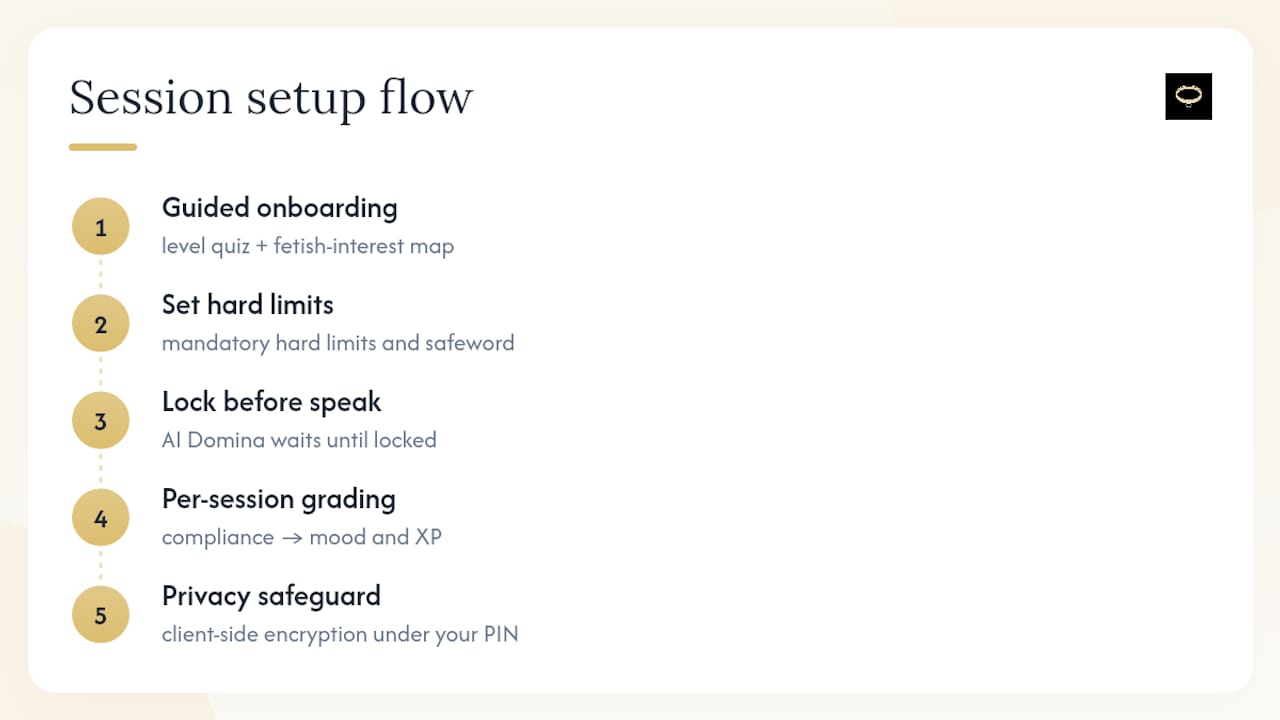
The privacy backbone matters just as much as the personalization. Sensitive quiz answers are encrypted client-side under a PIN only you hold, the same standard covered earlier in this piece, so the platform itself is structurally unable to read your personal data. If you want to explore terminology or activity categories before you take the quiz, the fetish library and BDSM glossary are open resources, and once you’re ready to see what a premium tier unlocks, from custom Domina creation to the AI Studio for opt-in image and video generation, the pricing page lays out the free, Premium, and Premium Plus tiers side by side.
Sources
- The Kink Orientation Scale: Developing and validating a measure of kink desire, practice and identity
- Factor structure and validation studies on measurement scales related to sexual sadism and the Agonistic Continuum
- Personality traits and psychosexual profiles among BDSM practitioners, implications for role assessment
FAQ
What Is a Level Assessment Quiz for AI BDSM Companions?
It’s an onboarding questionnaire that measures your experience, role preferences, hard and soft limits, and safeword, then uses those answers to personalize AI-driven scenes while keeping consent enforceable.
Does the Quiz Replace Real Negotiation Before a Scene?
No. A quiz sets the starting framework, but limits can shift with mood and context, so a quick recheck before each scene stays essential regardless of how experienced you are.
How Is My Quiz Data Kept Private?
Platforms like Mistrix use client-side encryption paired with a user-held PIN, meaning sensitive answers are scrambled on your device and the server never holds the key to read them.
Can I Retake the Quiz Later?
Yes, and you should whenever your interests, limits, or comfort level change, since an outdated assessment can lead an AI companion to suggest scenes that no longer fit you.
What If I’m Not Sure How to Answer a Question?
Use the neutral or “not sure” option instead of guessing. It exists specifically for acts you haven’t tried, and it keeps your results honest rather than performative.