
This article gives you categorized kink journaling prompts organized by purpose and role, plus practical, consent-first guidance for using them. You will find self-reflection, check-in, scene-processing, and growth prompts; role-specific angles for submissives, dominants, switches, and solo practice; and privacy steps to keep entries secure.
TL;DR:
- Regular journaling increases consistency by encouraging at least one weekly entry and a scene-specific entry within 48 hours, preventing habit abandonment.
- Specific prompts for impact play, degradation, or control help deepen honest self-exploration and improve scene communication over vague or general reflections.
- Role-based prompts tailored for submissives, dominants, switches, and solos guide more precise self-assessment relevant to each perspective.
- Using multiple formats like voice notes, collages, or trackers can make journaling more accessible and tailored to personal preferences, enhancing long-term engagement.
- Securing digital entries with PINs, encryption, and careful storage is crucial for honesty, since digital risks like shared devices or backups can threaten privacy.
Table of Contents
- Kink Journaling Prompts by Category
- Making the Habit Stick
- Prompts by Role: Submissive, Dominant, Switch, and Solo
- Pre-Scene and Post-Scene Check-In Prompts
- Finding a Journaling Format That Actually Fits
- Keeping a Kink Journal Private and Safe
- Journaling as a Consent and Communication Tool
- How Kink Journaling Supports Mental Health and Your Dynamic
- When Journaling Feels Hard: Common Blocks and Fixes
- Prompts for Exploring Specific Kinks and Fantasies
- Using Your Journal for Growth Beyond the Bedroom
- Try Guided Journaling Prompts With Mistrix
- Sources
- FAQ
Kink Journaling Prompts by Category
Every category here serves a different function, so pick based on what you need that week rather than working through all four at once.
Self-reflection prompts work best as a weekly practice, ideally on a day with no scenes planned, so you can think without the pull of a recent experience coloring the answer.
- What fantasy have I been avoiding writing down, and what does the avoidance tell me?
- Which kink discovery surprised me most this month?
- Where do I feel shame around a desire, and is that shame mine or borrowed from somewhere else?
- What does submission (or dominance) give me that I don’t get elsewhere in my life?
- What’s a hard limit I’ve never had to explain out loud, and could I explain it now?
- When do I feel most like myself in a scene?
Check-in prompts fit a biweekly or monthly rhythm and work well as shared entries between partners.
- What’s working in our dynamic right now that we haven’t said out loud?
- Is there a rule or ritual that’s started to feel like obligation instead of desire?
- What do I need more of: structure, spontaneity, or affirmation?
- Has anything shifted in my stress, health, or mood that affects my limits this month?
Scene-processing prompts belong right after a scene or within a few days.
- What moment felt like the peak of the scene, and why?
- What surprised me, good or bad?
- Did my safe word or check-in system feel accessible the whole time?
- What aftercare did I actually need versus what I asked for?
Growth and goals prompts suit a monthly or quarterly cadence. One useful entry point borrows from values card sort exercises used in motivational interviewing: pick three words that describe how you want to feel during a scene (safe, seen, stretched, owned) and write about why those three, not others.
- What skill or dynamic do I want to explore in the next three months?
- What would “mastery” of my current role even look like?
- Where has my kink identity changed most in the past year?
Making the Habit Stick
Journaling only pays off if you actually return to it. Structured, recurring journaling with a set minimum increases the odds you stay consistent, according to guidance from BDSM journaling resources, and the same principle shows up across most habit research: vague intentions fade, scheduled ones survive.
- Aim for one entry per week, plus one within 48 hours of any scene.
- Set a minimum word count per entry that encourages reflection without feeling like homework.
- If your dynamic includes a Dom who reads submissive entries, build in a response loop: the Dom reads, replies with a short note or question, and that reply becomes part of the next entry’s context.
- Use calendar reminders or a recurring task rather than relying on memory.
Pro Tip: Keep a one-page template with the date, the prompt used, and a single word for mood at the top. It takes ten seconds to fill in and makes old entries far easier to scan later.
Prompts by Role: Submissive, Dominant, Switch, and Solo
Your role shapes what you should actually be asking yourself. A submissive processing a hard scene needs different questions than a Dom auditing their own control.
- Submissive prompts. Try: “What did obedience feel like today, freely given or performed?” or “Where did I want to safeword but didn’t, and why?” A useful template for closing the loop: write the entry, then leave space at the bottom for a Dom’s response. A constructive reply might read, “I noticed you held back on saying you were tired. Next time, tell me before we start, not after.” That kind of reply teaches without shaming.
- Dominant prompts. Ask yourself: “Did I check in enough during that scene, or did I assume?” or “What does my partner’s body language tell me that their words don’t?” Dominants benefit from journaling their own limits too. Power exchange runs both directions.
- Switch prompts. Try: “Which role did I lean toward this month, and does that match what I actually wanted?” Switches often journal comparatively, tracking how the same kink feels from each side.
- Solo practice prompts. Ask: “What did I learn about my own arousal patterns without a partner’s presence shaping the answer?” Solo journaling is where a lot of genuine self-discovery happens, free of performance for someone else.
Whatever your role, keep the language nonjudgmental and specific. “I felt owned” is more useful than “it was good.”
Pre-Scene and Post-Scene Check-In Prompts
Scenes go smoother when the questions come before the rope does. A short pre-scene check protects everyone; a short post-scene entry protects the relationship.
Before a scene, ask:
- What’s my intent for this scene, beyond “have fun”?
- Are my hard limits from last month still accurate?
- Any physical concerns (injury, medication, fatigue) my partner should know?
- Is our safe word system clear and current?
After a scene, ask:
- What felt best, and what felt unexpectedly hard?
- What aftercare do I need right now versus in a day?
- Did anything happen that needs a longer conversation later?
Write immediate notes within an hour if you can, just fragments and feelings. Save the deeper reflective entry for 24 to 72 hours later, once the adrenaline has cleared and you can see the scene more honestly.
Finding a Journaling Format That Actually Fits
Typed entries aren’t the only option, and forcing yourself into a format that doesn’t fit your brain is the fastest way to quit.
- Timed freewrite (10 minutes, no editing) works when a feeling is raw and you need to get it out before you overthink it.
- Voice notes suit low-effort capture right after a scene, when typing feels like too much.
- Collage or visual boards help with mood work, especially for fantasies that resist words.
- Trackers work for pattern-spotting: log date, context, mood, a 1 to 10 score, and one action item per entry.
Try a few formats before committing. Small rituals, like a dedicated pen or a specific chair, tend to make the practice feel more significant and more likely to stick, whatever format you choose.
Keeping a Kink Journal Private and Safe
A kink journal is only useful if you feel safe being honest in it, and that means treating digital risk seriously. The biggest threats aren’t hackers. They’re a lost phone, an unlocked laptop, or a cloud backup syncing to a shared family account.
- Store entries behind a PIN or password separate from your phone’s main lock.
- Turn off automatic cloud backup for journaling apps, or use one with client-side encryption.
- Keep paper journals in a locked drawer, not a nightstand.
- Share select entries deliberately rather than granting a partner blanket access.
Journaling supports negotiation and self-awareness, but it doesn’t replace a formal consent conversation or a written agreement. Think of it as the space where you figure out what you want to say before you say it. If an entry brings up something distressing, expressive writing can occasionally surface difficult memories, so have a therapist, trusted friend, or support line in mind before you write about anything heavy.
Journaling as a Consent and Communication Tool
A journal entry you actually show your partner becomes a communication tool, not just a diary. This is where kink journaling earns its keep: it gives you a slower, written alternative to negotiating everything in the heat of the moment.
Writing down a boundary before you have to defend it out loud tends to produce clearer language. You’re not managing a partner’s reaction in real time, so you can name a limit precisely instead of softening it. Many dynamics use journal entries as a draft for a documented consent agreement, refining language over a few entries before it becomes a formal rule.
Check-in prompts also catch boundary drift early. A limit that felt firm three months ago might have softened, or a new one might have appeared that neither partner has named yet. Reading each other’s entries, even occasionally, surfaces those shifts before they turn into a bigger conversation nobody wanted to have. It also builds a habit of asking rather than assuming, which is the actual mechanism behind good consent practice, not just a policy on paper.
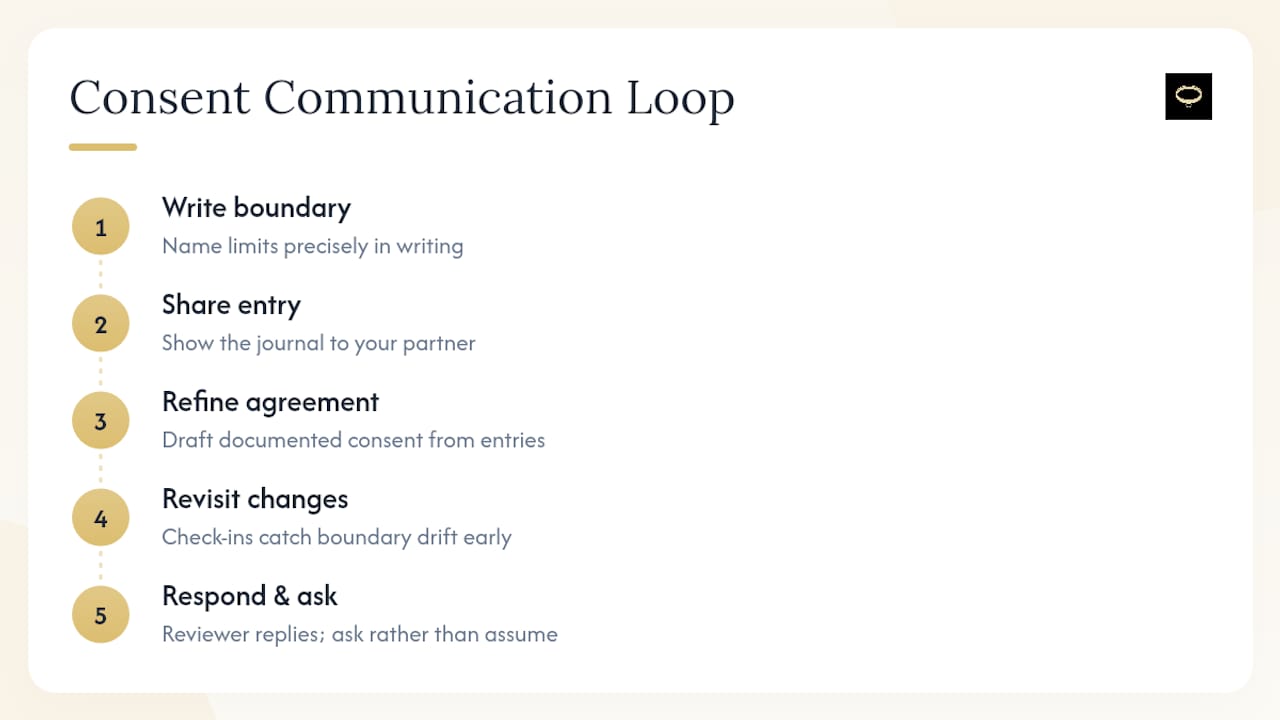
For dynamics with an established Dom who reviews entries, the reading and responding itself becomes part of the ritual. A submissive’s raw, unfiltered reflection gets a considered response instead of silence, which turns journaling into a two-way practice rather than a one-way vent.
How Kink Journaling Supports Mental Health and Your Dynamic
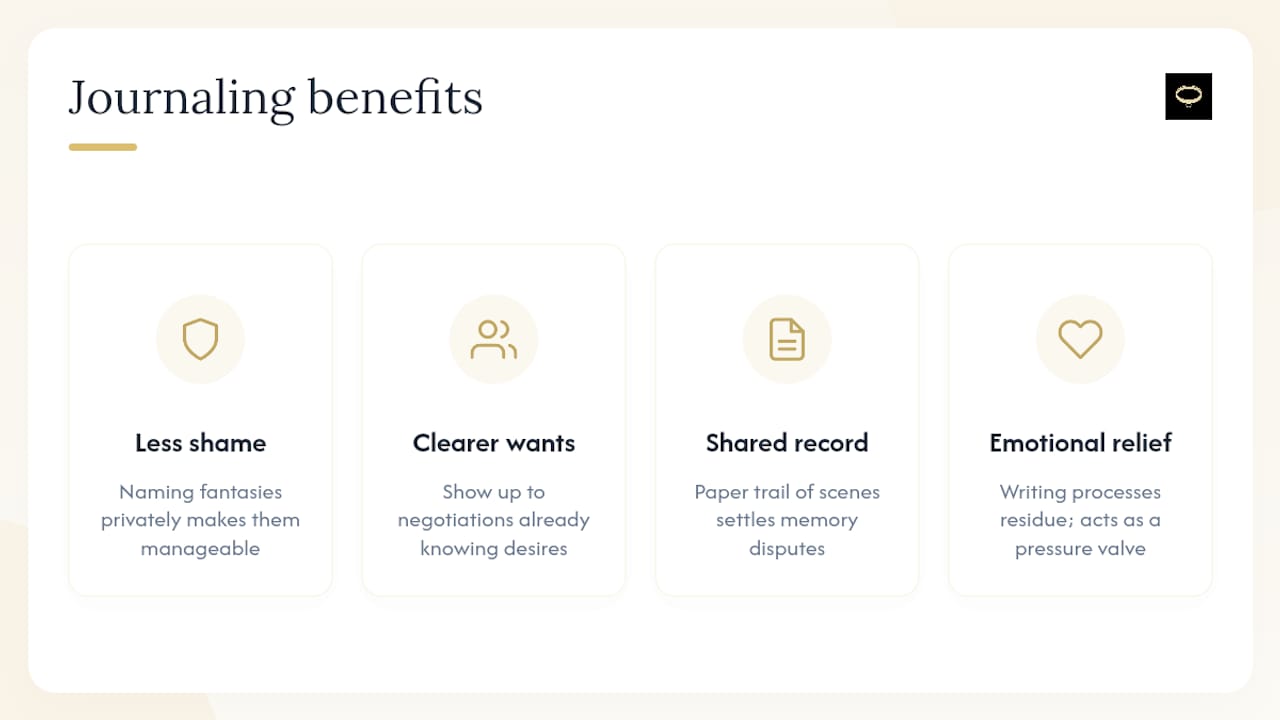
Writing about desire regularly does something most people don’t expect: it reduces the shame that tends to build up around kink when it stays entirely unspoken. Naming a fantasy on paper, even privately, tends to shrink it down to something manageable rather than something looming.
Journaling is a recognized tool for sexual self-awareness, useful whether you practice alone, with a partner, or alongside a therapist. That self-awareness pays off directly in a dynamic: you show up to negotiations already knowing what you want instead of discovering it mid-conversation.
For relationships specifically, a shared or partially shared journal builds a paper trail of what actually worked. Memory is unreliable, especially about emotionally charged scenes, and two partners often remember the same night differently. An entry written within a day of a scene settles that dispute before it starts.
There’s a mental health angle too. Processing an intense scene through writing gives the nervous system something structured to do with leftover adrenaline or emotional residue, rather than letting it sit unexamined. That doesn’t replace therapy for anyone working through trauma, but as a regular practice, it functions as a pressure valve. Couples who journal consistently also tend to report fewer blowups over unaddressed resentment, mostly because small frustrations get written down and addressed before they compound into something bigger.
When Journaling Feels Hard: Common Blocks and Fixes
Almost everyone who starts a kink journal hits a wall, usually within the first month. Here’s what that wall tends to look like and what actually helps.
Blank-page paralysis happens when the prompt is too broad. “Write about your kinks” is nearly impossible to start; “what surprised me this month” is not. Swap broad prompts for specific ones whenever you freeze.
Shame about the words on the page is common, especially early on. Writing “I want to be degraded” or “I get off on control” in plain English can feel exposing even to yourself. This fades with repetition. The first ten entries are almost always the hardest.
Inconsistency kills more journaling practices than any other single factor. If a week gets skipped, the instinct is to quit rather than restart. Treat a missed week as a missed week, not a failed practice, and pick the next scheduled entry back up.
Fear someone will find it stops a lot of people before they start. This is a real risk, not an irrational one, and it’s worth solving with actual security (PINs, encryption, careful storage) rather than by avoiding honesty in your own entries.
Not knowing what counts as “enough” trips up people who want every entry to be profound. It doesn’t need to be. Short, honest entries beat long, performed ones every time.
Prompts for Exploring Specific Kinks and Fantasies
Generic prompts work for general reflection, but specific kinks benefit from specific questions that push past the surface-level “I like this” answer.
For impact play: What does the anticipation feel like compared to the impact itself? Is there a specific implement or rhythm that changes the experience?
For degradation or humiliation play: What’s the difference between a word that turns me on and a word that would actually hurt? Where’s that line, and has it moved recently?
For power exchange and control: What does “giving up control” actually feel like in my body, not just my head? Is there a moment where I want to take control back, and what does that mean?
For financial domination: What’s the emotional payoff behind the transaction itself, separate from the money? A useful angle here often overlaps with broader findom dynamics, where the psychology matters more than the numbers.
For rope or bondage: What does stillness let me feel that movement doesn’t? Is there a difference between physical restriction and the feeling of being restricted?
For roleplay and persona work: Which parts of the persona feel like play, and which parts feel like a truer version of me showing through?
Pick one specific kink per entry rather than surveying all of them. Depth beats breadth here, and a narrow question almost always produces a more honest answer than a broad one.
Using Your Journal for Growth Beyond the Bedroom
The best kink journals eventually stop being just about scenes. Patterns that show up in a dynamic (needing control, craving surrender, fearing judgment) usually trace back to something bigger than kink itself.
Someone who journals honestly about submission for six months often starts noticing the same themes at work: discomfort with authority, or a hunger for structure they don’t get elsewhere. That’s not a coincidence. Kink identity and general identity aren’t separate systems; they share wiring. A journal that only tracks scenes misses that connection entirely.
Try occasionally widening the lens. Ask: “Where else in my life do I want the same thing I want in a scene?” or “What does this dynamic teach me about how I handle vulnerability generally?” These questions turn a kink journal into a genuine self-discovery tool, not just a record of encounters.
This is also where a fetish-interest map becomes useful alongside journaling. Mapping out what draws you in, and then journaling about why, gives you both the what and the why in one practice. Over time, that combination reveals more about your values, boundaries, and desires than either tool would alone.
Try Guided Journaling Prompts With Mistrix
If you want the structure without building it yourself, Mistrix offers guided kink journaling built into ongoing sessions rather than a static prompt list you have to remember to open. Onboarding includes a fetish-interest map and mandatory hard-limit setup, so the prompts your AI Domina proposes are already shaped around what you’ve said you want and what’s off the table. Every sensitive entry is protected with a client-side PIN, meaning even Mistrix’s own servers can’t read it. That’s a meaningfully different privacy model than a notes app syncing to the cloud.
Sessions build on each other over time instead of starting from zero each week, and you can choose or create a Domina personality, including gentle femdom styles for readers who want structure without harshness. Check the pricing page to see what’s included in the free tier versus Premium, and start with a session to see how a guided prompt compares to a blank page.
Sources
- Navigating the Complex Tapestry of Sexuality Through Journaling
- Motivationalinterviewing
- Expressive writing (URMC Encyclopedia)
FAQ
What is the 3-3-3 journaling method?
The 3-3-3 method asks you to write for three minutes, three times a day, on whatever comes to mind. Applied to kink journaling, it works well for quick pulse-checks around a scene rather than deep reflection.
What is the 3/2-1 method of journaling?
The 3-2-1 method has you write three things you learned, two things that surprised you, and one thing you want to explore further. It fits growth-and-goals prompts particularly well, since it forces a forward-looking close to each entry.
What are some good journal prompts for submissives?
Strong submissive prompts ask about the difference between freely given obedience and performed obedience, unspoken hesitations during a scene, and what submission provides that other parts of life don’t.
What are some fun journal prompts for adults?
Lighter prompts work well too: “What kink discovery made me laugh this month?” or “If I could design one dream scene with no limits except consent, what would it look like?” Fun entries keep the practice from feeling like homework.
How often should I journal about kink?
A weekly entry plus one within 48 hours of any scene tends to build consistency without becoming a burden.
Is it safe to keep a digital kink journal?
Yes, as long as you use device-level security, disable automatic unencrypted cloud backups, and choose tools that don’t have server-side access to your entries.