
A moderation system for a consent-first adult AI companion app must do four things at once: validate every uploaded and generated image, enforce each user’s hard limits and safe word, run mandatory CSAM checks before anything else happens, and process it all with zero data retention so bytes never linger past the decision. The app’s approach follows this model, built on privacy-preserving classifiers like LAION’s CLIP-based NSFW detector, not a bolt-on content filter.
TL;DR:
- The moderation system enforces strict CSAM hash matching before any other processing, ensuring illegal content is identified immediately and reported to authorities.
- Content is scored against user-specific hard limits and fetish maps, with thresholds adjusted to balance between overly strict and too lenient filtering.
- All image data is deleted immediately after moderation decisions, with only hashes and metadata retained, under client-side encryption protected by user-held PINs.
- Human review processes are limited to decision metadata and image summaries, with review rotations and capped sessions to reduce reviewer burnout and exposure risks.
- Regular monitoring through A/B testing and audit logs helps maintain moderation accuracy and adapt to evolving models, user behavior, and platform policies.
Table of Contents
- What Does Image Moderation Look Like in an Adult AI App?
- How Do Thresholds and Human Review Actually Work?
- Turning Product Consent Rules Into Enforcement Logic
- What Privacy Rules Govern Image Data Retention?
- On-Device Models, Secure Enclaves, or Voting Stacks?
- How Should Reviewer Escalation and CSAM Reporting Work?
- What Operational Habits Keep Moderation Accurate Over Time?
- How Mistrix Puts This Playbook Into Practice
- Sources
- FAQ
What Does Image Moderation Look Like in an Adult AI App?
Most commercial image filters assume one job: keep NSFW content off a mainstream platform. A consent-first companion app has the opposite challenge. Adult and fetish imagery is the product, so moderation has to distinguish between content the user explicitly wants, content that crosses their own hard limits, and content that’s illegal regardless of anyone’s preferences. That third category gets zero debate. Everything else runs through layers.
Layer 1: CSAM hash matching. Every image, uploaded or generated, gets checked against known-hash databases first, before any other processing touches it. This is non-negotiable and sits apart from every other feature flag in the system.
Layer 2: classification and scoring. A model like LAION’s CLIP-based NSFW detector scores the image against categories tied to the user’s own hard limits and fetish map, not a generic “adult or not” binary.
Layer 3: sanity and quality checks. Catches malformed generations, artifacts, or outputs that don’t match the requested prompt before they reach the user.
Layer 4: output verification. Generated images get re-scored after generation, since a model can drift from the prompt’s intent even when the prompt itself was compliant. Grove’s Petal specification documents this exact four-layer structure for privacy-first image moderation, pairing it with immediate deletion after processing.
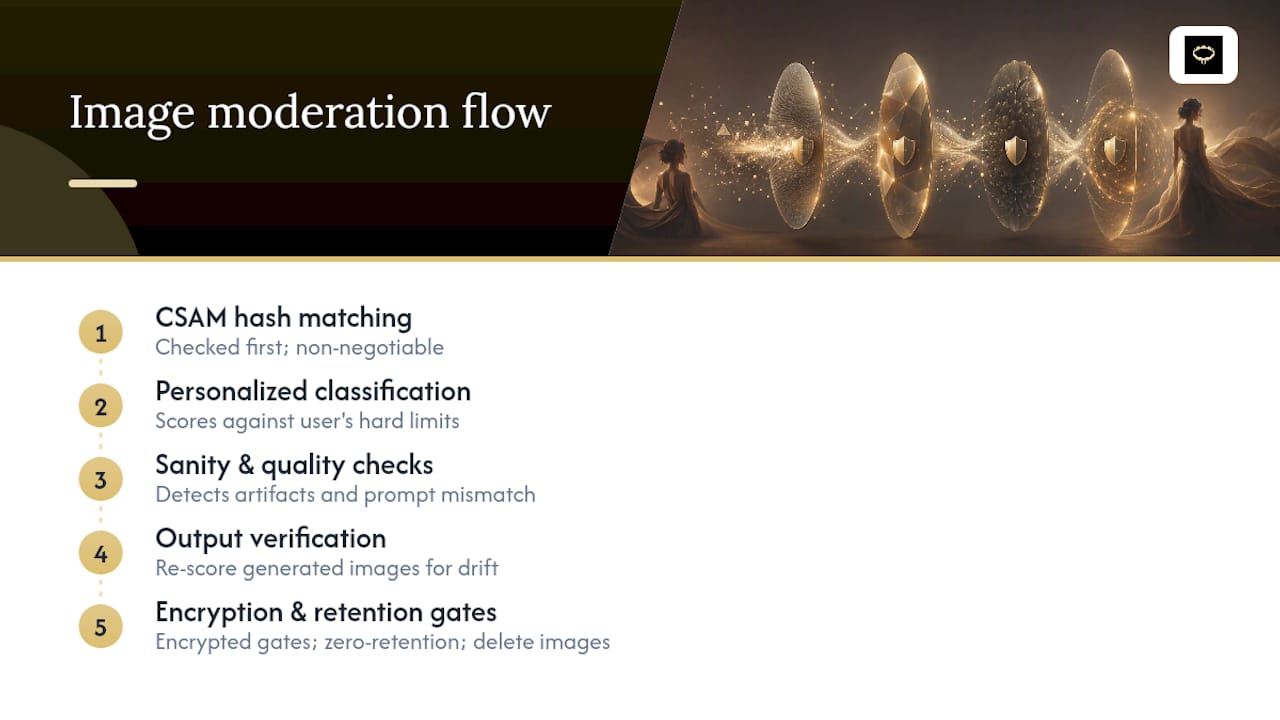
Client-side encryption and zero-data-retention gates sit between every layer and permanent storage. What gets logged is decision metadata: the outcome, a timestamp, a hash. What never gets logged is the image itself.
How Do Thresholds and Human Review Actually Work?
Thresholds decide how aggressively the system quarantines borderline content, and getting them wrong in either direction breaks trust. Too strict, and consensual fetish content the user explicitly opted into gets blocked constantly. Too lenient, and hard limits stop meaning anything.
- Set threshold presets. A strict preset (roughly 0.50 on a 0 to 1 NSFW score), a balanced preset (around 0.70), and a lenient preset (around 0.90) give operators a starting point, a pattern documented in Backblaze’s sample moderation pipeline. Consent-first apps generally run closer to balanced for general content and strict for anything touching a stated hard limit.
- Route flagged content to quarantine. Quarantined images get held, not deleted, and not shown, while only the hash and decision metadata get retained, never the pixel data itself.
- Fast-track CSAM matches. Any hash match skips quarantine entirely and moves straight into the mandatory reporting workflow, with no user-facing appeal step.
- Offer a limited appeal path. For everything short of CSAM, users can contest a quarantine decision through a masked-preview or descriptor-only review, never a raw-image reviewer queue.
Turning Product Consent Rules Into Enforcement Logic
The hard limits and safe word a user sets during onboarding aren’t just profile settings. They’re the parameters the moderation layer actually enforces on every single generation request.
- Onboarding capture: mandatory hard limits, a safe word, a fetish-interest map, and explicit opt-in before image generation unlocks at all.
- Runtime enforcement: session-level toggles let a user turn off image generation entirely mid-session, and invoking the safe word halts generation immediately and triggers an aftercare flow rather than just closing a chat window.
- Evolving consent: a relationship that deepens over weeks of memory and session history can drift past what someone agreed to on day one. Research on AI companionship calls this a temporal mismatch between initial consent and relational depth, and the fix is periodic re-consent prompts triggered as memory or intimacy escalates, not a one-time checkbox.
This logic is built directly into onboarding through a level-assessment quiz and fetish-interest map, so hard limits aren’t a static list buried in settings. They’re active parameters the AI checks against before every scene.
What Privacy Rules Govern Image Data Retention?
Retention policy is where a lot of adult platforms quietly fail their users, either by keeping images “for quality” or by not being explicit about what actually gets deleted.
- Zero data retention for image bytes: delete the image immediately once a decision is made, whether that decision is approved, quarantine, or reject.
- Retain only what’s mandatory: decision metadata and content hashes, kept for a documented, narrow window, and never the images themselves.
- Client-side encryption with user-held PINs: when a PIN never touches the server, the platform is structurally incapable of reading a user’s sensitive images, which is a stronger guarantee than a privacy policy promise.
- CSAM-specific retention: store only the hashes and metadata required for NCMEC reporting, restrict access to a small, defined group, and set retention windows in consultation with legal counsel rather than by default.
This exact model is applied: sensitive data gets encrypted client-side with a PIN the server never sees, and image bytes don’t outlive the moderation decision.
On-Device Models, Secure Enclaves, or Voting Stacks?
Three engineering paths handle the classification layer, and each carries a different privacy and cost profile.
- On-device CLIP-based scoring. Running a model like LAION’s CLIP ViT-L/14 detector locally means image bytes never leave the operator’s infrastructure. It runs on CPU, Apple’s MPS, or CUDA, and the Backblaze sample pipeline shows a working reference implementation with staging, quarantine, and JSONL/CSV audit exports. The trade-off is maintenance: someone has to keep the classifier current as generation models evolve.
- TEEs and secure enclaves. When a device can’t run a classifier locally, a trusted execution environment lets cloud inference happen without the operator (or anyone else) reading the raw image during processing. The CETAS privacy-preserving moderation paper frames TEEs as a middle ground between full on-device processing and standard cloud APIs, at a higher infrastructure cost.
- Voting stacks. Running multiple classifiers in parallel and aggregating their scores, an approach documented in open-source projects like SafeEyes, can reduce false positives through weighted confidence rules. The trade-off is a larger privacy surface, since more providers means more places an image could theoretically touch.
For a consent-first app, the order of preference should run local first, enclave second, and multi-provider voting only when accuracy demands outweigh the added exposure. Structured-output classifiers like VisionGuardrail-9B are worth a look too. They return reasoning alongside a flag, which makes audit logs far more useful when someone appeals a decision later.
How Should Reviewer Escalation and CSAM Reporting Work?
CSAM scanning happens first, before classification, before quality checks, before anything else. When a hash match occurs, the reporting timeline to NCMEC is not optional, and the system should preserve only the hashes and metadata required for that report.
- Protect reviewers from raw exposure. Use masked previews or descriptor-only summaries for any human-review step; no reviewer should ever be the one opening a raw sexual image to make a judgment call.
- Rotate reviewers and cap session length. Extended exposure to flagged content is a documented burnout and harm risk for trust and safety teams, so shift limits matter as much as accuracy.
- Keep a legal escalation path. Ambiguous cases, ones that aren’t clearly CSAM but aren’t clearly consensual adult content either, need a defined route to counsel rather than a reviewer’s best guess.
- Document without retaining. Audit trails should capture the decision and the reasoning behind it, never the image that triggered it.
What Operational Habits Keep Moderation Accurate Over Time?
A moderation system tuned once and left alone drifts. Generation models change, user expectations shift, and thresholds that felt right in January can feel punitive by summer.
- A/B test your thresholds. Track false positive and false negative rates against real user friction, not just raw accuracy numbers.
- Watch retention alongside accuracy. A system that blocks too aggressively drives away exactly the paying users who trusted the platform with their hard limits in the first place.
- Keep audit logs narrow and time-boxed. Log decision metadata only, for a documented window that supports appeals and investigations without becoming its own data liability.
- Watch for manipulative design patterns, not just legal risk. Investigations into AI companion products have flagged psychologically manipulative behaviors in intimacy-focused apps as a safety issue distinct from legal compliance, and moderation policy should account for both.
Pro Tip: Separate your permission model into three distinct switches: memory, sexual content generation, and image generation. Bundling them into one “adult mode” toggle makes accidental exposure more likely and makes your moderation logic far harder to audit later.
How Mistrix Puts This Playbook Into Practice
Everything above is the theory. Mistrix is where it becomes a product decision made once, at onboarding, instead of a setting you have to remember to configure. The guided onboarding flow runs a level-assessment quiz and builds a fetish-interest map before a single scene ever starts, capturing hard limits and a safe word as mandatory steps, not optional ones. Enforcement doesn’t stop there: the safe word halts an active session mid-generation, and your AI Domina checks stated limits against every scene it proposes, not just the ones you flag manually.
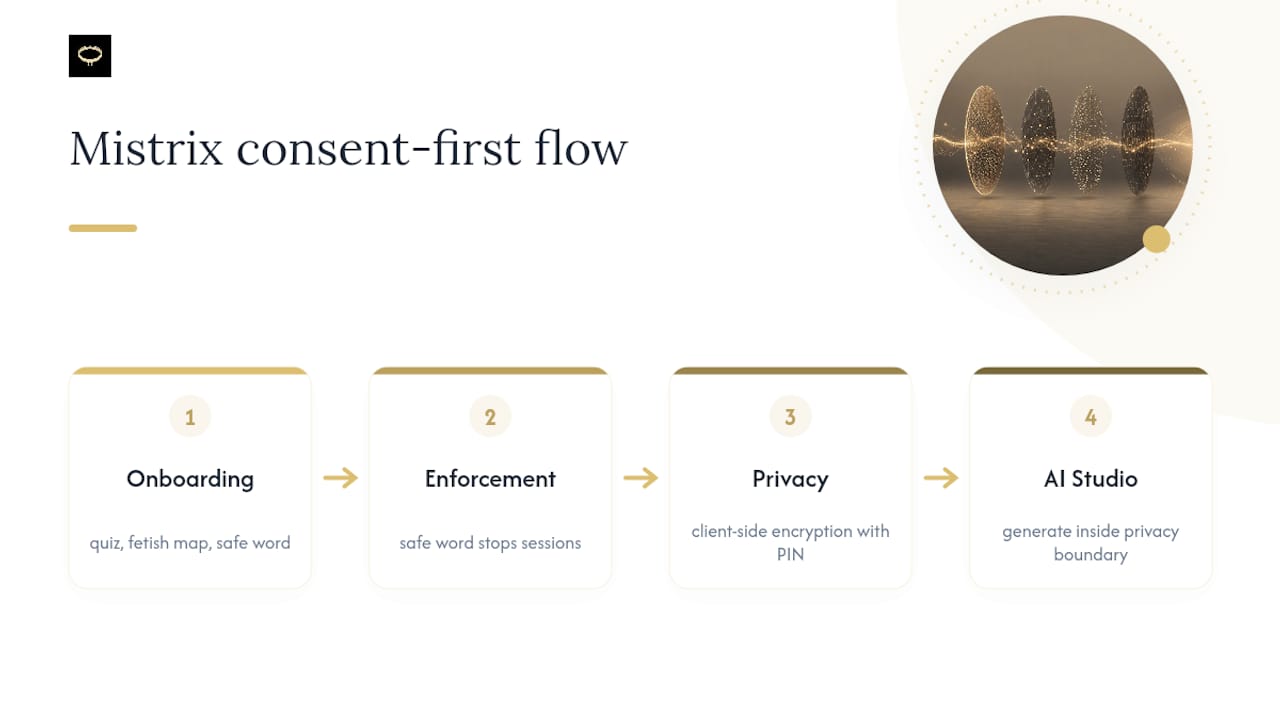
Privacy runs through the same pipeline. Sensitive data gets encrypted client-side with a PIN the server never sees, so image and session data stay structurally unreadable to anyone but you. The built-in AI Studio generates custom images and short video clips inside that same privacy-first boundary, with output verification running before anything reaches your gallery. If you’re evaluating what consent-first actually looks like in a live product rather than a spec document, browse the Domina personalities and see how hard limits shape the experience from the first session onward.
Sources
- backblaze-b2-samples/clip-nsfw-image-moderation (GitHub)
- Privacy-preserving moderation of illegal online content (CETAS / Turing Institute)
- Incentivising intimacy: AI developers cashing in on romantic chatbots (The Bureau Investigates)
FAQ
What Is Image Moderation for Adult AI Apps?
It’s the layered process of screening uploaded and AI-generated images for legality, consent compliance, and user-set hard limits, using classifiers like CLIP-based NSFW detectors alongside mandatory CSAM checks.
Does Adult Content Filtering Mean Blocking All NSFW Images?
No. In a consent-first app, filtering means checking content against each user’s own hard limits and safe word, not applying a blanket adult content ban.
How Is CSAM Detection Different From Regular Content Filtering?
CSAM hash matching runs first, before any other classification step, and any match triggers mandatory reporting rather than a quarantine or appeal process.
Can Image Moderation Work Without Storing My Photos?
Yes. Zero-data-retention pipelines delete image bytes immediately after scoring and keep only a hash and a decision record, a model Mistrix applies through client-side PIN encryption.
What Happens When Generated Images Cross a Hard Limit?
The output verification layer re-scores generated images against the user’s stated limits before delivery, and a violation blocks the image before it ever reaches the user.