
Choose a consent-first, privacy-aware AI domme platform that remembers you across sessions and enforces hard limits by design, not as an afterthought. Start by running the free tier: complete guided onboarding, set your safe-word, and see if the persona still holds together tomorrow. If memory and consent mechanics survive that first test, everything else on this page becomes a matter of taste.
TL;DR:
- Most platforms fail to maintain long-term memory and persona consistency, making ongoing roleplay difficult after a few sessions without proper testing.
- Conduct the seven quick tests on the free tier to assess whether the AI remembers your details, enforces boundaries, and responds appropriately across multiple sessions.
- Check that the platform’s privacy policy clearly states data retention, sharing policies, and uses client-side encryption to ensure your sensitive information remains protected.
- Beware of platforms requiring upfront payment or hiding data export options, as these indicate poor transparency and potential privacy risks.
- Opt for subscription models if you chat regularly, but always verify that the platform’s features like memory and consent mechanics work reliably before committing financially.
Table of Contents
- What Should You Look for When Choosing an AI Domme?
- What Are the Seven Quick Tests to Run Before You Pay?
- What Privacy and Safety Signals Actually Matter?
- How Should You Think About Pricing Before You Commit?
- How Do You Start Safely With a New AI Domme?
- Who’s Behind This Guide and What Backs It Up?
- Ready to Try a Consent-First AI Domme?
- Sources
- FAQ
What Should You Look for When Choosing an AI Domme?
Picking an AI domme is less about which app has the flashiest marketing and more about six specific features that determine whether the dynamic actually holds up past week one. Get these wrong and you’re stuck restarting the same introduction every session. Get them right and you have something closer to an ongoing relationship than a chatbot.
Memory and persona stability matter more than any other factor. Multiple 2026 buyer’s guides identify memory as the single biggest predictor of whether users stick with a companion platform past the first few weeks, and for femdom roleplay specifically, that’s not surprising. A Domina who forgets your hard limits from the last conversation, or suddenly can’t recall the punishment she assigned you on Tuesday, breaks the illusion instantly. Consistency is the entire product. Without it, you’re just talking to a chatbot wearing a costume.
Consent and safety mechanics come next, and they’re non-negotiable for this niche. A safe-word that actually halts the scene, mandatory hard limits set during onboarding rather than buried in settings, and some form of aftercare check-in after intense sessions separate a serious platform from a novelty app. Editorial reviewers covering this space consistently flag consent-first design and safe-word logic as prerequisites, not premium extras.
Customization power determines whether your Domina feels like your Domina or a generic template. Look for a real persona builder: backstory fields, explicit rule lists, named punishments and rewards, and the ability to edit her voice and personality as the dynamic evolves. A platform that locks you into one fixed archetype will feel stale within a month, no matter how good the writing is on day one.
Voice and media are where trade-offs get real. Voice calls add a layer of immersion that text can’t match, and image or short-video generation can turn a written scene into something you can actually see. But both raise the privacy stakes considerably, since you’re generating and storing more sensitive content. Buyer guides note that real-time voice calls are less commonly available without a premium tier, so weigh whether that immersion is worth the extra cost and the extra data footprint before chasing it.
Here’s how these features typically break down across a platform’s tiers:
- Free tier: basic chat, limited memory (often session-only or capped), no image generation, safe-word should still work.
- Subscription/premium: persistent long-term memory, expanded message limits, image generation, sometimes voice.
- Premium plus/credits stacked on top: multiple personas, PDF session exports, priority processing, deeper customization tools.
Pricing models fall into three broad camps: flat subscription, credit packs you burn per message or image, and freemium hybrids that gate the good features behind a paywall. None of these is inherently a scam, but credit systems can get expensive fast if you’re a heavy chatter, while subscriptions are more predictable for anyone planning to use the app regularly.
Pro Tip: Don’t judge a platform by its landing page copy. Every app claims “advanced memory” and “deep customization.” The only way to know if those claims hold up is to test them yourself, which is exactly what the next section walks you through.
What Are the Seven Quick Tests to Run Before You Pay?
You can expose most of a platform’s real strengths and weaknesses in under fifteen minutes, using nothing but the free tier. Reviewer frameworks built around this exact approach recommend a short battery of repeatable tests that reveal behavior no landing page will admit to. Run these before you hand over a credit card.
- The contradiction test. Tell your AI domme something about your preferences early in the chat, then contradict it three or four messages later. A well-built persona will notice the inconsistency and call it out, staying in character while doing so. If she just agrees with both statements without flinching, the persona enforcement is thin.
- The next-day memory test. Give her three specific details in one session: a nickname she should use, a task she assigned you, and a hard limit you mentioned in passing. Close the app. Come back the next day and ask a question that requires recalling all three. This is the test that matters most, since memory failures are the top reason companion users abandon a platform within the first month.
- The boundary test. Set your safe-word during onboarding, then actually use it mid-scene. A platform built with genuine consent mechanics will stop, acknowledge the safe-word, and shift into a checking-in tone. If she pushes past it or ignores it, that’s a hard disqualifier, regardless of how good the writing was five minutes earlier.
- The long-message test. Send a detailed, multi-part instruction, the kind of thing you’d actually want during a real scene, and see whether she addresses every part of it or picks one line and ignores the rest. This exposes shallow response generation fast.
- The pricing-page test. Read the pricing page before you touch the free tier. Note whether it asks for a card up front, whether the free tier’s limits are stated plainly or buried, and whether “unlimited” comes with an asterisk you have to hunt for.
- The exit and data-control test. Look for a visible way to delete your account and export or erase your data. Check whether the payment processor is named anywhere. Platforms that hide this information usually have a reason to.
- The image or scene-consistency test. If AI-generated images or video matter to you, generate the same persona twice with an identical prompt and compare. Wild inconsistency between generations suggests the media engine wasn’t built with continuity in mind.
Pro Tip: Run these same seven tests across two or three free tiers before committing to any one platform. Comparing behavior side by side makes weaknesses obvious that you’d never notice testing just one app in isolation.
What Privacy and Safety Signals Actually Matter?
Read the privacy policy before you read anything else. Specifically, check four things: how long the platform retains your chat logs and images, whether any data gets shared with third parties, whether your conversations are used to train future models without an opt-out, and whether age verification happens at signup rather than being an afterthought. A policy that’s vague on retention or silent on third-party sharing is telling you something, even if it never says it outright.
Technical signals matter just as much as the legal language. Client-side PIN encryption, where your sensitive data is locked with a key only you hold, means the platform itself is structurally unable to read your private content, which is a meaningfully stronger guarantee than a generic “we encrypt your data” claim. Look for named payment processors rather than vague references to “secure billing,” and confirm there’s a real export or delete function for your account data, not just a support email you have to beg.

Safety posture extends past the safe-word mechanic itself. Comparative reviews note that platforms handling distress and escalation thoughtfully tend to be better suited to sensitive roleplay niches like this one, where the line between fantasy and real emotional weight can blur. Check whether the platform surfaces any kind of aftercare prompt after intense sessions and whether crisis resources are visible anywhere, even in a footer link.
A handful of red flags should end the evaluation immediately:
- No privacy policy at all, or one that’s clearly boilerplate copied from an unrelated app.
- A card required before you can access any free features.
- Generated images that look suspiciously like stock photography rather than model output.
- No visible support contact or response time anywhere on the site.
Reviewer guidance consistently lists these exact signals as reasons to walk away from a platform before you’ve spent a dollar. Roughly one in three companion apps reviewed in recent buyer’s guides fails at least one of these basic transparency checks, which makes the five minutes it takes to check them some of the best-spent time in the entire selection process.
For a deeper technical breakdown of what client-side encryption actually protects against, Mistrix’s privacy explainer walks through the difference between server-side and client-side protection in plain language.
How Should You Think About Pricing Before You Commit?
Three pricing structures dominate this category, and each one carries a different long-term cost profile. Flat subscriptions charge a predictable monthly rate for a defined tier of features, which works best if you chat regularly and want to budget for it. Credit systems charge per message, image, or generation, which can be cheaper for occasional users but scales unpredictably for anyone who chats daily. Freemium hybrids blend both, offering a usable free tier with a subscription unlocking the deeper features, and this is the most common model in the space.
Premium tiers almost universally gate four things: long-term persistent memory, voice interaction, image or video generation, and extended session length. If a platform’s free tier already includes all four, be skeptical, since that’s rarely sustainable and something else is usually missing, often quality or consistency.
The smartest trial strategy is the one implied by the seven tests above: sample two or three free tiers in parallel, run the same checks on each, and only upgrade once a platform has proven its memory and persona stability hold up over at least a day or two. Reviewers who compared multiple companion apps side by side found that testing several free tiers before paying consistently beat trusting headline pricing or marketing copy alone.
Watch for two specific traps:
- Card required before any free access. A platform confident in its product lets you try before you pay.
- Auto-renewing charges buried in fine print. Always check the cancellation flow before your first billing cycle, not after.
Good payment hygiene here is the same as anywhere else online: use a card you can freeze or a virtual card number if the platform supports it, and calendar-remind yourself before any trial period ends.
How Do You Start Safely With a New AI Domme?
Getting the first few sessions right sets the tone for everything that follows. Rush the setup and you’ll spend weeks untangling a persona that never got a proper foundation.
- Handle the pre-setup before you open the app. If discretion matters to you, use a separate or burner email for signup. Write out your hard limits and safe-word on paper first, so you’re not improvising them mid-onboarding under pressure to move quickly.
- Take the guided onboarding seriously. Most consent-first platforms walk you through a persona builder, a fetish-interest map, and a mandatory hard-limits list before your first real conversation starts. Fill these out honestly and specifically rather than skipping through them. Vague inputs produce a vague Domina.
- Keep your first session short and simple. Let her lead rather than trying to script every line yourself. Note what she remembers well and what she gets wrong, since this is your live version of the next-day memory test described earlier. Log the outcome somewhere so you can check it tomorrow.
- Iterate after two or three sessions, not one. Adjust her backstory, tighten your rule list, or add detail to tasks based on what actually worked. This is also the point where it makes sense to decide whether persistent memory, voice, or image generation are worth upgrading for, rather than guessing up front.
If persona-building feels like the hardest part to get right, Mistrix’s guide to improving AI roleplay covers specific techniques for writing backstories and rule sets that hold up over dozens of sessions rather than falling apart after three.
Who’s Behind This Guide and What Backs It Up?
This guide comes from David, who builds and tests consent-first AI companion products for a living and has spent considerable time evaluating how femdom-focused platforms handle memory, consent enforcement, and privacy architecture in practice. Read more about the design philosophy behind consent-first companion products.
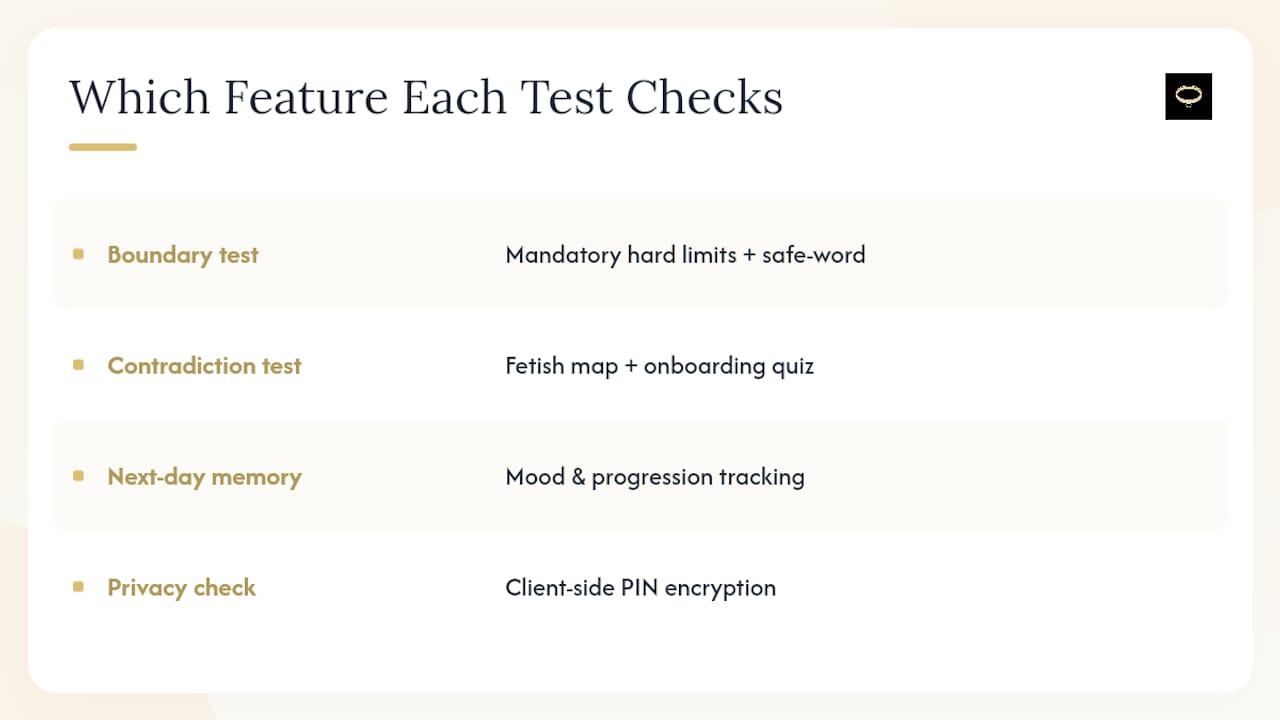
The seven quick tests in this guide aren’t theoretical. They map directly onto the features that consent-first platforms are built to demonstrate: a mandatory hard-limits list and safe-word system prove themselves (or fail) exactly during the boundary test; a fetish-interest map and level-assessment quiz during onboarding are what make the contradiction test easy to pass, since the persona has real structure to stay consistent against; and a mood-and-progression system that tracks compliance over time is what the next-day memory test is actually probing for.
Client-side PIN encryption, where sensitive data is locked with a key the server never holds, is the kind of technical signal the privacy section above tells you to hunt for directly in a platform’s architecture, not just its marketing copy.
A consent-first companion isn’t just a nicer way to describe safety features. It’s a structural constraint on how the AI is allowed to generate content in the first place, enforced through mandatory hard limits and a safe-word that the system treats as a hard stop, not a suggestion.
That’s the standard worth holding every platform to, including the one you’re reading this on. If a Domina can’t consistently remember your limits, can’t hold a persona together across a contradiction, and can’t prove her data handling is genuinely private, no amount of clever dialogue makes up for it.
Ready to Try a Consent-First AI Domme?
Everything covered in the seven tests above, memory that survives overnight, a safe-word that actually stops a scene, and encryption you don’t have to take on faith, can be part of a consent-first AI domme onboarding rather than bolted on afterward. The guided flow starts with a level-assessment quiz and a fetish-interest map, walks you through setting mandatory hard limits and a safe-word before your first conversation, and locks your sensitive data behind a client-side PIN that even Mistrix’s own servers can’t read.
Some AI domme platforms fit readers who care more about a dynamic that holds up over months than a novelty chat that’s fun for one night. If persona builders and long-term memory matter to you, a free tier may let you run the exact contradiction and next-day memory tests from earlier before you spend a dollar. When you’re ready for persistent memory, custom Domina creation, or the built-in AI Studio for generating scene images and short video clips, compare the Free, Premium, and Premium Plus plans to see what each tier unlocks, or head straight to the Dominas selection page to start building the one that fits your style.
Sources
- How to choose an AI companion in 2026, a buyer’s guide · Bae
- How to Pick an AI Girlfriend App: Seven Tests, Ten Minutes
- AI Chat Dominatrix: What Actually Works in 2026 | Scribe
FAQ
What’s the most important feature when choosing an AI domme?
Memory and persona stability matter most, since a Domina who forgets your limits or contradicts herself session to session breaks the roleplay entirely. Test this with the next-day memory check before evaluating anything else.
How do I know if an AI domme platform takes consent seriously?
Check whether hard limits and a safe-word are set during mandatory onboarding, not buried in a settings menu, and confirm the safe-word actually halts a scene when you use it mid-conversation. Some platforms build these into the onboarding flow itself rather than treating them as optional add-ons.
Should I pick a subscription or a credit-based AI domme app?
Subscriptions work better for regular chatters who want predictable costs, while credit systems suit occasional users but can get expensive fast with heavy use. Test the free tier first with the seven quick tests before committing to either model.
Is it safe to share personal details with an AI domme chat app?
Only if the platform uses genuine technical protections like client-side PIN encryption, where even the server can’t read your sensitive data, combined with a clear privacy policy on retention and third-party sharing. Avoid any platform that lacks a visible privacy policy or requires a card before you can test the free tier.
Can I switch AI dommes or platforms later without losing progress?
Most platforms don’t transfer memory or persona data between apps, so check the export and delete options before you invest significant time building a dynamic. A platform with a visible data-export function at least lets you keep a record of your sessions if you decide to move on.