
This is a categorized collection of femdom roleplay ideas built for real use tonight, not someday. You get seven idea categories, three ready-to-run scene templates, and the negotiation and aftercare steps that keep every scenario consent-first. Resources like SubTasks and Mistrix inform the structure, and every idea below adapts to your dynamic’s tone, gear, and experience level.
TL;DR:
- Permission protocols, such as asking before actions, are beginner-friendly, require no gear, and help establish structured control in scenes.
- Negotiating clear hard and soft limits, safewords, and check-in routines before each scene reduces risks and ensures mutual safety.
- Using simple props like blindfolds or soft cuffs enhances sensory play without needing advanced skill or expensive equipment.
- Building a sustainable dynamic involves starting with a few rituals, tracking responses, and gradually increasing complexity based on mutual satisfaction.
- Practicing scenes through AI tools like Mistrix enables safe rehearsal, personalized scenario generation, and adherence to boundaries before engaging with a partner.
Table of Contents
- What Are the Best Femdom Roleplay Ideas by Category?
- Three Scene Templates You Can Run Tonight
- How Do You Negotiate and Stay Safe in Femdom Scenes?
- What Gear Actually Helps, and What’s Optional?
- How Do You Build a Femdom Dynamic That Lasts?
- What Does Aftercare Actually Sound Like?
- How Mistrix Helps You Plan and Practice Femdom Scenes
- Try Mistrix for Privacy-First Femdom Practice
- Sources
- FAQ
What Are the Best Femdom Roleplay Ideas by Category?
Femdom roleplay works best when you pick a flavor before you pick a scene. A “strict teacher” mood needs different pacing than a “worship” mood, and mixing them without warning tends to confuse rather than excite. The categories below borrow from common archetypes: Corporate Boss, Strict Disciplinarian, Goddess figure, and Governess all show up repeatedly in femdom roleplay because they give both partners an instant, recognizable power frame to step into.
Here are the seven core flavors, with beginner-friendly options marked so you know where to start.
Digital dominance (no gear, beginner-friendly)
- Permission protocols: your partner texts before any orgasm, meal, or even a glass of water for a set window.
- Timed check-ins: a submissive sends a photo or status update at scheduled hours, graded on promptness.
- Silent chat command: you send one instruction per hour and they must confirm compliance with a single word.
Service and worship (low gear, beginner-friendly)
- Foot or hand worship rituals with a timer, where duration is the “task” rather than technique.
- Morning service: coffee, stretching assistance, or a specific chore completed before either of you speaks.
- Verbal worship script: your partner recites three things they appreciate about your authority before bed.
Training and discipline (moderate skill, negotiate limits first)
- Posture correction: a standing or kneeling position held during a set activity like watching TV.
- Obedience drills: a short sequence of commands (kneel, hands behind back, eyes down) practiced until fluid.
- Corrective tasks: a missed check-in earns an assigned essay, chore, or repetition, agreed on in advance.
Sensual ritual (low gear, beginner-friendly)
- Goddess worship scene: incense, robe, and a scripted devotion where your partner addresses you by a chosen title.
- Denial ritual: a scheduled tease-and-deny session with a strict stopping point set beforehand.
- Bathing ceremony: you direct, they perform, with grooming or washing framed as an honor to earn.
Impact and restraint (higher skill, requires negotiation and possibly practice)
- Light spanking scenes tied to a “scorecard” for the day’s obedience.
- Wrist or ankle cuffs during a scripted interrogation or “punishment” scene.
- Sensory teasing with a blindfold, paired with verbal degradation or praise depending on your dynamic’s flavor.
Public and discreet protocols (advanced, requires strong trust)
- A silent hand signal during dinner that means “you’re being watched, behave.”
- An agreed-upon code word texted mid errand that triggers a private task later.
- Discreet jewelry or clothing that signals ownership without anyone else noticing.
Brat taming and playful control (moderate skill, good for couples who like banter)
- A “smart mouth tax”: every sarcastic comment earns a small, pre-agreed consequence.
- Chase-and-catch scenes where resistance is part of the game, with a clear stop signal.
- Playful interrogation: you extract a “confession” through teasing rather than force.
Every one of these works as a standalone scene or as a building block for a longer dynamic. SubTasks notes that daily, small rituals like morning greetings and service verifications sustain a hierarchy far better than occasional intense scenes, especially in long-distance dynamics. Pick two or three from different categories rather than trying all seven at once.
Three Scene Templates You Can Run Tonight
Beginner scene templates that skip gear and rely on structure tend to build confidence faster than prop-heavy scenes, according to PlayfulMag. Here are three, each with a negotiation step, a beat sheet, and an aftercare line.
-
Silent Service. Negotiate first: confirm a safeword, agree on the task list (cleaning, foot rub, fetching items), and set a time limit. Begin by telling your partner they may not speak until released. Assign three to five small tasks, correcting posture or pace as needed. Release them with a single word and transition into aftercare: a few minutes of quiet touch and a simple “you did well.”
-
Orgasm Control Night. Negotiate the ceiling (how many denials, whether completion happens) and the safeword before anything starts. Open with a permission rule: no touching without asking aloud. Build through two or three denial cycles, checking in verbally between each (“color check” works well here). Close with either a release or a firm, affectionate denial, followed by cuddling and a debrief on what felt good.
-
Obedience Training. Confirm hard limits and a stop gesture in case verbal safewords aren’t practical mid-scene. Start with basic commands: kneel, hands folded, eyes down. Escalate to a short drill sequence, praising fluid compliance and gently correcting mistakes. End with a “graduation” moment, verbal praise, and five to ten minutes of aftercare talk about the experience.
For shy dominants, run any of these three over text first. Send the entrance line, the task, and the release cue as separate messages with real-world time gaps. Remote versions work well for couples who travel or want to build confidence before an in-person scene.
How Do You Negotiate and Stay Safe in Femdom Scenes?
Negotiation and aftercare aren’t optional extras. Multiple sources treat safewords, pre-scene checklists, and structured aftercare as mandatory, not aspirational, parts of any femdom dynamic. Skipping them doesn’t make you more advanced; it just makes the scene riskier for both people.
Before any scene, walk through this checklist together:
- List hard limits (never, under any circumstance) and soft limits (maybe, with more trust).
- Choose a safeword or, for scenes involving gags or silence, a physical gesture like dropping an object.
- Share medical conditions, allergies, or physical restrictions that affect impact, restraint, or breath play.
- Agree on a check-in cadence: a color system (green, yellow, red) works for verbal scenes; a squeeze system works for nonverbal ones.
Escalate intensity gradually. Run a lighter version of a scene first, debrief afterward, and only add intensity (longer denial, firmer commands, restraint) once both partners confirm the lighter version felt good. Red flags that mean you should stop immediately include silence where check-ins are expected, a safeword being used and ignored, or either partner dissociating rather than engaging.
Pro Tip: Keep a running shared note, digital or physical, listing what worked and what didn’t after each scene. Six months in, that note becomes your best planning tool.
Aftercare doesn’t need to be elaborate. A few minutes of physical closeness, plain language check-in (“how are you feeling, really?”), and permission to be quiet if that’s what’s needed cover most scenes. If either partner feels off for days afterward, pause the dynamic and talk outside of any power frame.

What Gear Actually Helps, and What’s Optional?
Most of the ideas above need zero equipment. A voice, a clear task, and a willing partner cover permission protocols, worship rituals, and obedience drills. When you do want props, a few low-cost items add real texture without demanding skill you don’t have yet.
- Blindfolds heighten focus during service or sensory scenes and cost very little.
- Soft cuffs (velcro or fabric) support restraint scenes without the learning curve of rope.
- App-controlled toys let you direct pleasure or denial from across the room, or across a city.
- Timed-release text apps work for permission protocols when you’re not physically together.
- Photo-proof protocols (a task photo sent on request) extend service scenes into daily life.
For remote or app-enabled play, keep device permissions and photo-sharing settings locked down. Privacy is part of the scene, not an afterthought.
How Do You Build a Femdom Dynamic That Lasts?
A sustainable dynamic behaves like a small, testable system rather than a series of one-off performances. Start with one daily ritual (a morning check-in text), one weekly task (a chore or service session), and one scene template from the three above. Run that combination for two weeks before changing anything.
Ask a few calibration questions early: does your partner respond better to a stern tone, a nurturing one, or something worship-flavored? Do they want praise for compliance or consequences for mistakes? PlayfulMag points out that psychological structure, permission control, denial, and ritual tends to sustain a dynamic more reliably than jumping straight into complex physical play.
- Track compliance and mood in a shared note or app.
- Reward consistency with a small privilege or a scene upgrade, not just praise.
- Mark milestones (one month, one year) with a slightly bigger ritual or scene.
- Retire ideas that feel stale by naming it directly rather than letting them fade awkwardly.
Pro Tip: If a task stops generating any reaction, good or bad, that’s your cue to swap it out. Boredom is a signal, not a failure.
What Does Aftercare Actually Sound Like?
Aftercare scripts don’t need to be complicated, but having a few ready removes the awkward pause after an intense scene.
- Physical comfort script: “Come here, just breathe with me for a minute.” Followed by quiet holding, no talking required.
- Low-talk debrief: “One word for how that felt?” Then, a few minutes later, “Anything you want to do differently next time?”
- Space-respecting check-in: “I’m here whenever you’re ready to talk. No rush.” Then step back and let them come to you.
Unexpected tears, giggling, or a sudden need for distance are all normal nervous-system responses, not signs something went wrong. If a low mood or disconnect lasts more than a day or two, pause the dynamic and have a conversation entirely outside of any dominant or submissive role. Outside support (a therapist familiar with kink) is worth involving if that pattern repeats.
How Mistrix Helps You Plan and Practice Femdom Scenes
Planning a scene solo, or wanting to rehearse a scenario before bringing it to a partner, is exactly where Mistrix fits. The onboarding flow runs a level-assessment quiz and builds a fetish-interest map, so your AI Domina proposes scenes that actually match your experience rather than generic templates. Hard limits and your safeword are mandatory settings enforced on every generation, and all sensitive data gets client-side PIN encryption that the platform itself can’t read. The AI Studio lets you practice scene structure and generate custom visuals privately, turning the ideas above into a rehearsed, personalized script before you ever run them live.
Try Mistrix for Privacy-First Femdom Practice
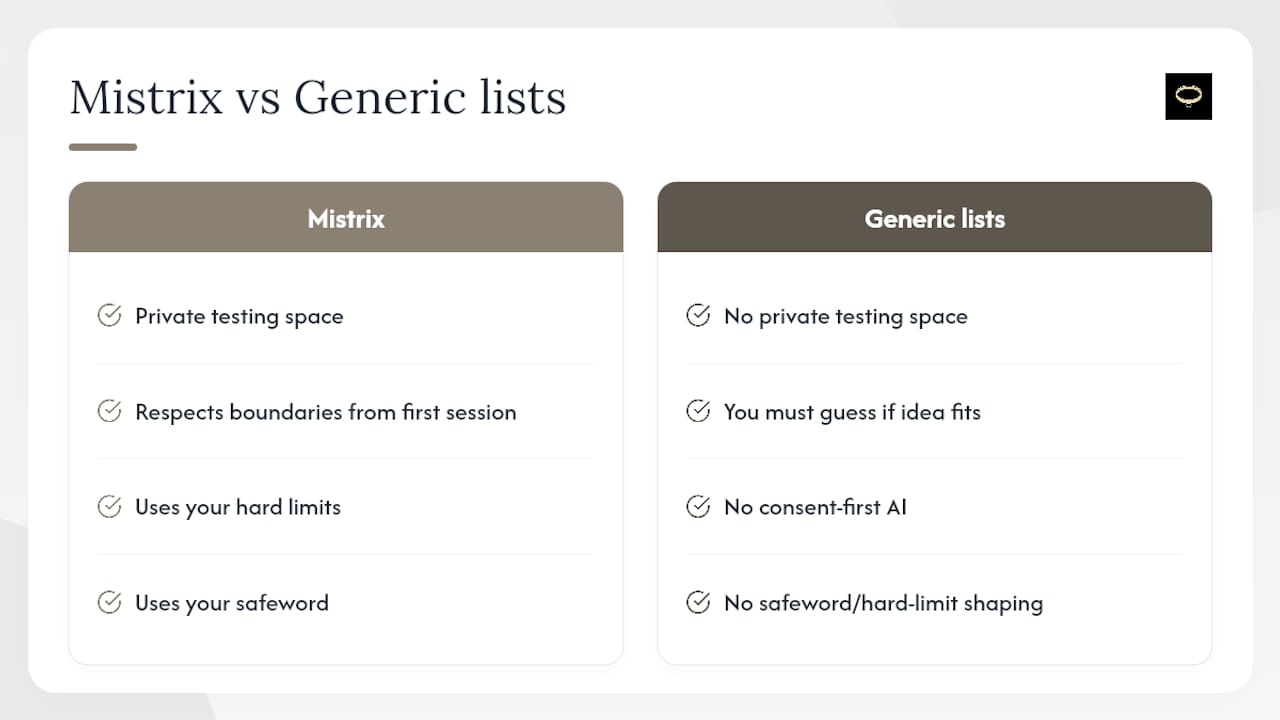
Building a femdom dynamic from scratch, whether solo or with a partner, gets easier when you have a private space to test scripts, tone, and pacing before they matter. Mistrix gives you an AI Domina shaped by your own hard limits and safeword from the first session, so every scene you generate already respects your boundaries. That’s the difference from generic scene lists: instead of guessing whether an idea fits your dynamic, you can run it through a consent-first AI first and see how it feels. Whether you’re drawn to the strict discipline templates above or the gentler worship and service style, you can build a custom Domina personality that matches. Explore the BDSM and fetish library to see the full range of dynamics Mistrix supports, then start your own guided onboarding to build a Domina suited to exactly what you want to practice.
Sources
If you want to go deeper on any category above, a few sources informed the structure of this guide. SubTasks catalogs fifty task ideas built specifically for female-led dynamics, useful if the service and ritual categories appealed to you. PlayfulMag breaks down beginner scene templates in more depth, including variations on the three above. Their companion list of mood-shifting ideas covers psychological dominance techniques in more detail. Lovense’s idea roundup offers a broader spread of over a hundred ideas graded by skill level, worth browsing once you’ve tried the basics here.
- Femdom Task Ideas: 50 Tasks for Female-Led Dynamics, SubTasks Blog
- Beginner femdom scene templates you can actually use, PlayfulMag
FAQ
What Is the Easiest Femdom Roleplay Idea for Beginners?
Permission protocols, where your partner asks before small actions like eating or touching themselves, require zero gear and build structure fast, which makes them a strong starting point.
How Do You Negotiate a Femdom Scene Before Starting?
Walk through hard limits, soft limits, a safeword or gesture, and any medical notes together, then agree on a check-in cadence like a color system before the scene begins.
What Should Aftercare Include After a Femdom Scene?
Aftercare should include physical comfort, a brief low-pressure debrief, and space to process quietly if that’s what your partner needs; even five minutes of intentional connection matters.
Can You Practice Femdom Roleplay Without a Partner?
Yes. Platforms like Mistrix let you build a private AI Domina, set your own hard limits and safeword, and rehearse scene structure and dialogue before trying it with a partner.
How Do You Keep a Femdom Dynamic Interesting Long-Term?
Rotate one daily ritual, one weekly task, and one scene template every two weeks, and retire ideas that stop generating a reaction rather than forcing them to continue.