
Consensual non-consent (CNC) means both partners agree in advance to a scene where one person acts out resistance, force, or refusal that isn’t real. The core safety rule that makes it work: explicit, detailed negotiation beforehand, ongoing attention to how your partner is actually doing, and an unconditional override signal that stops everything, no matter what the scene “script” says. CNC carries real legal exposure too, since courts increasingly expect proof of consent beyond a conversation that happened days earlier.
TL;DR:
- Explicit, ongoing negotiation is essential, including clear boundaries, safewords, and capacity checks to ensure consent is current and revocable during CNC scenes.
- Use a meta-safeword that is unlikely to appear in the scene, and establish non-verbal signals or third-party observers for high-risk activities involving restraints or unconsciousness.
- Document all agreements, including limits and surprises, and reconfirm consent at each scene start to minimize legal exposure and build trust.
- Avoid CNC with partners who rush negotiation, are intoxicated, or show resistance to aftercare, as these signs indicate insufficient readiness or trust.
- Legal protection requires evidence of active, ongoing consent; a single prior agreement is usually insufficient if not reinforced during the scene.
Table of Contents
- What Consensual Non-Consent Actually Covers
- Building Your Pre-Scene Negotiation Checklist
- Safewords, Signals, and Watching for Trouble Mid-Scene
- Aftercare Isn’t Optional, It’s Where the Real Work Happens
- Where the Law Draws the Line on CNC
- The Community Debate Over CNC’s Risks
- Why Trust This Guide
- Where to Go Deeper
- Sources
- FAQ
What Consensual Non-Consent Actually Covers
CNC is a broad category, not one specific act. It’s the umbrella term for scenes where the “no” is performed, not real, and the whole erotic charge comes from that gap between fiction and fact.
Common forms include:
- Rape roleplay, where one partner plays a resistant or unwilling role during a scripted encounter
- Sleep or unconscious play, where a partner pretends to be (or actually falls) asleep while the other continues sanctioned activity
- Capture or kidnapping scenes, often blending struggle, restraint, and psychological intensity
- Ongoing power exchange dynamics, where one partner has standing permission to initiate CNC-style scenes without a fresh negotiation every time
What separates CNC from abuse isn’t the intensity of the acting. It’s whether real, informed agreement exists before the scene starts and whether that agreement can be revoked. Fictive coercion is theater built on a foundation both people helped design. Real coercion ignores or overrides someone’s actual wishes. The line gets blurry precisely because CNC intentionally simulates the thing it isn’t, which is exactly why the Kink Codex’s guidance on consensual coercion calls it the BDSM practice requiring the most detailed pre-scene planning of any kink activity.
CNC isn’t appropriate for every relationship or every night. It tends to work best between partners who already have practice reading each other’s nonverbal cues, who’ve done lower-intensity scenes together, and who have the emotional bandwidth that week to hold space for something psychologically heavy. It’s a poor fit when either partner is in crisis, when trust hasn’t been tested through smaller scenes first, or when one person is pressuring the other to “prove” commitment by agreeing to it.
Building Your Pre-Scene Negotiation Checklist
The community principle here is “negotiate in, not out.” Instead of listing everything you don’t want and assuming the rest is fair game, you build the scene up from explicit agreements. DanceSafe’s mutual consent framework treats this kind of structured pre-scene discussion as the single biggest predictor of a safe outcome, and CNC raises the stakes on every category below.
Work through these eight areas before anything happens:
- The container. When does the scene start and end? Is there a signal that marks “this is play” so nobody wonders later if it was real?
- Activities explicitly in and out. Name specific acts, words, and physical actions you’re each opting into, not vague categories like “rough stuff.”
- Reservation conditions. What has to be true for the scene to proceed at all: sobriety, a certain mood, a private space, a specific time window?
- Information disclosure. Do you know your partner’s trauma history, physical limitations, or trigger words well enough to run this scene responsibly?
- Power exchange language. Decide which scripted phrases mean “keep going” even though they sound like refusal, so nobody confuses scene dialogue with real distress.
- Safewords and non-verbal signals. Set a meta-safeword that lives entirely outside scene vocabulary, plus a backup for when speech isn’t possible.
- Aftercare plan. Agree on what happens in the first ten minutes after the scene ends and who initiates it.
- Capacity checks. Confirm both people are sober, of sound mind, and free from coercion at the moment of negotiation and again right before the scene.
Separate your limits into hard limits (never, under any circumstance) and soft limits (maybe, with the right conditions), and consider a simple yes/no/maybe list for specific acts. Write it down. A dated note, a shared document, or a checklist app gives you something concrete to revisit if memory gets fuzzy weeks later, which is exactly the kind of record Mistrix’s guide to documenting consent recommends keeping.
If you want an element of surprise inside the scene, negotiate the boundaries of the surprise in advance rather than the surprise itself. Agree on a defined “surprise window,” meaning you know roughly what category of unexpected thing might happen and you’ve already said yes to that category, even if you don’t know the exact moment.

Pro Tip: Run a “no surprises” version of the scene the first time you try any new CNC element. Once you’ve both seen how it plays out fully scripted, you’ll have a much better read on whether adding real spontaneity later is a good idea.
Safewords, Signals, and Watching for Trouble Mid-Scene
CNC scripts often include the word “no” as part of the performance, which makes a standard safeword system dangerous if it’s not designed carefully. Your meta-safeword has to be a word or phrase that would never plausibly appear in the scene itself. “Pineapple” works. “Stop” does not, because “stop” is probably already in the script.
Layer your system so a single point of failure doesn’t leave anyone stuck:
- A spoken meta-safeword for when talking is possible and safe
- A non-verbal backup, such as tapping three times, dropping a held object, or a hand signal, for scenes involving gags, restraints, or face-down positioning
- A spotter or third party in higher-risk scenes, someone not directly involved who watches for signs of real distress and can call a stop unilaterally
- A freeze word distinct from the full-stop safeword, for pausing without fully ending the scene
The Kink Codex’s community research on consensual coercion specifically recommends non-verbal backups because CNC scenes frequently involve exactly the conditions, restraint, sensory overload, feigned unconsciousness, that make speech unreliable.
Watch your partner’s body, not just their words. Dissociation can look like blank staring, sudden stillness, or a partner who stops tracking what’s happening around them. Panic often shows up as rapid shallow breathing, tensed limbs that won’t release, or repetitive movements. Real physiological distress, tears that don’t stop, gagging, numbness in restrained limbs, needs an immediate pause regardless of what the scene calls for.
The moment an override signal fires, stop the physical activity first and ask questions second. Get restraints off, adjust positioning, and check in verbally before doing anything else. Community guidance from organizations like the NCSF’s BDSM safety resources treats this immediate, no-questions-asked stop as non-negotiable groundwork for any high-intensity scene, CNC included.
Aftercare Isn’t Optional, It’s Where the Real Work Happens
CNC scenes can leave both partners in an altered emotional state, sometimes hours after the physical activity ends. Aftercare is how you both come back down and confirm the trust that made the scene possible in the first place.
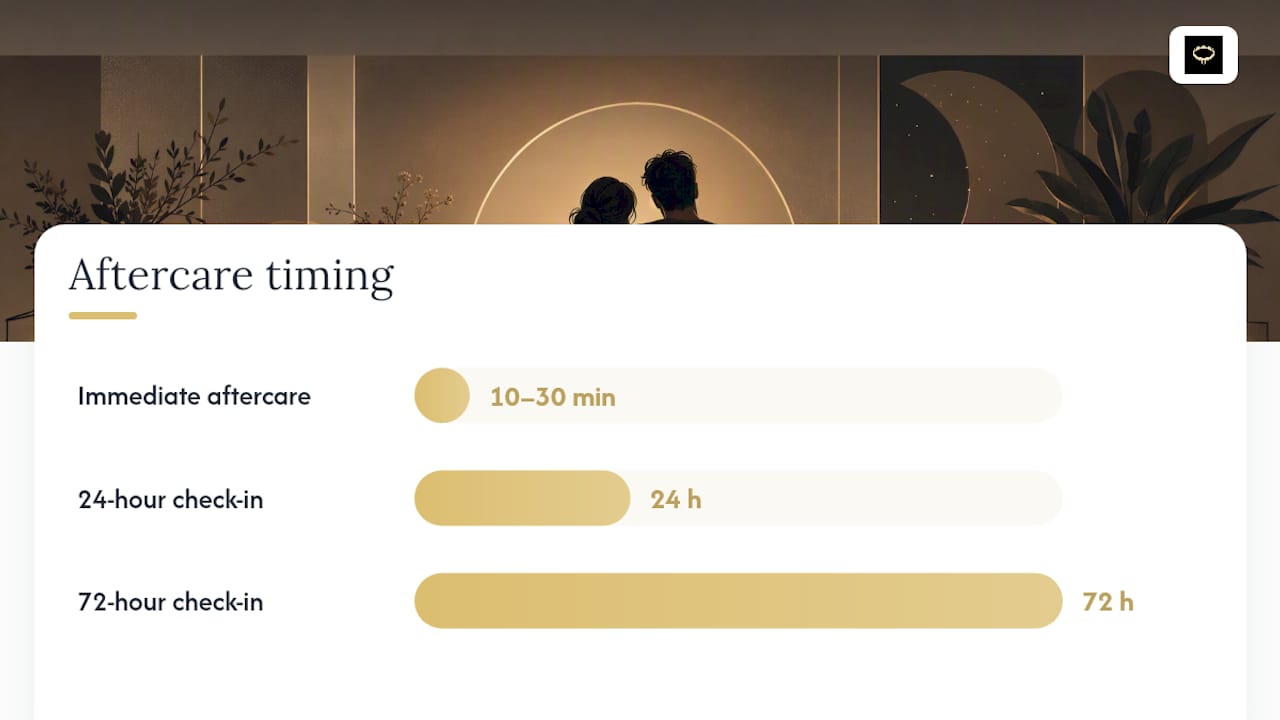
Immediate aftercare, the first 10 to 30 minutes, usually includes:
- Physical comfort: blankets, water, food, or simple touch if that’s wanted
- A quiet space with no immediate demands or conversation about “how it went”
- Removing any gear, restraints, or costume elements that signal the scene isn’t over yet
- A short debrief once both people are grounded, focused on how each felt rather than critiquing performance
Extended aftercare stretches further. Check in again at 24 hours, and again around 72 hours, since delayed emotional reactions to intense scenes are common and don’t always surface immediately. Journaling individually, then comparing notes later, can surface reactions neither partner voiced out loud in the moment.
If a scene didn’t go the way it was negotiated, whether because a limit got crossed unintentionally or an override signal was missed, the dominant partner in that dynamic owns the repair conversation. That means naming what happened plainly, without minimizing it, and asking what the other person needs rather than explaining why it wasn’t really a big deal. Playful Mag’s writing on CNC psychology frames trust in these dynamics as something built through repeated, reliable follow-through rather than a single good conversation, which is exactly why the repair step matters as much as the negotiation did.
Pro Tip: Keep a standing aftercare kit, water, snacks, something soft, ready before the scene even starts. Fumbling to find a blanket while someone is emotionally raw undercuts the whole point of aftercare.
Where the Law Draws the Line on CNC
Advance agreement to a CNC scene doesn’t automatically protect either partner if something goes legally wrong. The revised Model Penal Code’s sexual assault provisions introduced the concept of Explicit Prior Permission (EPP), and legal commentary on the update makes clear that courts may treat consent negotiated once, in advance, as insufficient if there’s no evidence of ongoing consent indicators during the encounter itself.
That distinction matters practically. A conversation from three weeks ago establishing that CNC is generally okay doesn’t prove consent existed at 11 p.m. on a specific Tuesday. Legal scholarship examining CNC-related cases has found that courts favor evidence of active, contemporaneous negotiation over a one-time blanket agreement, particularly when a dispute arises after the fact.
Explicit Prior Permission asks a harder question than “did they agree once.” It asks whether the agreement was specific, current, and revocable at the moment things actually happened. A scene that skips ongoing check-ins in favor of a single advance conversation is the exact pattern legal scholars flag as vulnerable.
Steps that reduce legal exposure without killing the scene’s intensity:
- Keep dated, written negotiation notes, even brief ones, stored somewhere private
- Use a spotter for high-risk scenes involving choking, restraint of the airway, or extended immobilization
- Avoid extreme-risk practices entirely if you don’t have direct training, some acts carry injury or fatality risk that no negotiation checklist offsets
- Reconfirm consent verbally or through a check-in ritual at the start of each scene, not just the first time
- Consult a lawyer familiar with sexual assault statutes in your state if you have specific concerns about a past incident or an ongoing dynamic
None of this makes CNC risk-free from a legal standpoint. It does make the difference between a defensible practice and a legally exposed one.
The Community Debate Over CNC’s Risks
CNC sits at an uncomfortable intersection of established safety frameworks. Safe, Sane, and Consensual (SSC) asks whether an activity is inherently safe, and simulated non-consent scenes stretch that definition by design. Risk-Aware Consensual Kink (RACK) fits more comfortably, since it accepts that some acts carry irreducible risk as long as everyone understands and accepts it. FRIES, Freely given, Reversible, Informed, Enthusiastic, Specific, is where CNC gets genuinely tested, since the entire point of the scene is performing a lack of enthusiasm. Community guidance from groups like the NCSF generally supports CNC when the underlying agreement meets FRIES criteria even if the performance doesn’t look like it.
Watch for these red flags before agreeing to a CNC scene:
- A partner who rushes negotiation or treats it as an obstacle to get through
- Hostility or eye-rolling toward the idea of aftercare
- Any pressure to drop your safeword, shorten it, or “prove trust” by not using one
- A new partner suggesting CNC before you’ve done lower-intensity scenes together
- Either person being intoxicated, in active crisis, or carrying unresolved trauma related to the specific act being proposed
If any of these show up, the honest answer is to wait, not to push through.
Why Trust This Guide
This article draws on established BDSM negotiation frameworks, current legal scholarship on consent, and the same safety principles Mistrix bakes into its platform design. David, who oversees editorial content at Mistrix, has spent years covering consent frameworks and kink safety practices for the platform’s guided-session content and onboarding design.
Structured tools help reduce the room for error, even though they never replace a real conversation between real partners:
- Guided onboarding flows that walk users through hard limits before any scene begins
- Enforced hard-limit lists that block certain content categories outright, rather than relying on memory in the moment
- Built-in safe word systems that carry over across sessions instead of resetting each time
- Client-side PIN encryption on sensitive preference data, so what you disclose stays private by design
Technology can structure the negotiation. It can’t have the negotiation for you, and it can’t read your partner’s body language in the room. That part stays entirely human.
Where to Go Deeper
For legal nuance, the UC Law Review’s analysis of the Model Penal Code’s sexual assault provisions is the clearest academic breakdown available. Practitioners looking for negotiation scripts should start with DanceSafe’s mutual consent toolbox and the Kink Codex’s consensual coercion guide, both of which offer concrete checklists rather than theory. For community standards and safety framing, the NCSF’s BDSM FAQ remains a widely cited reference point across kink education circles. Mistrix’s own kink safety checklist rounds out general negotiation practice beyond CNC specifically.
Sources
- Consenting to change: The new sexual-assault provisions of the Model Penal Code
- Navigating mutual consent agreements: Lessons from BDSM negotiations (DanceSafe)
- Consensual coercion (Kink Codex / KnowYourKinkCode)
- BDSM FAQ and consent frameworks (NCSF / community resource)
FAQ
What Does Consensual Non-Consent Include?
CNC includes any pre-negotiated scene where a partner performs resistance, refusal, or unconsciousness that isn’t real, ranging from rape roleplay and capture scenes to sleep play and scripted power-exchange dynamics.
What Is an Example of CNC Play?
A common example is a scripted “kidnapping” scene where one partner is restrained and verbally resists while the other proceeds with previously agreed-upon activities, with a meta-safeword available to stop the scene instantly if needed.
Can a 16-Year-Old Consent to a 28-Year-Old?
No. Consent to any sexual activity, including CNC, requires legal capacity, and minors cannot legally consent to sexual activity with adults regardless of any agreement made; capacity checks exist specifically to rule out situations involving minors, intoxication, or coercion.
What Are Some Examples of Non-Consensual Consent Scenarios?
The phrase usually points to situations where agreement was given under pressure, intoxication, or incomplete information, none of which meet the bar for real consent, as distinct from properly negotiated CNC where all parties are sober, informed, and free to revoke agreement at any time.