

AI sexting is not automatically private, no matter what a landing page promises. Your privacy depends entirely on how the platform is built, what it stores, and what its policy actually says versus what it markets. The three risks that matter most: your conversations get logged and retained longer than you think, your chats can get fed into model training without a real opt-out, and breaches happen more often than the industry admits. This guide shows you how to evaluate any platform against those three risks, plus what to do right now to lower your exposure.
TL;DR:
- Many platforms store conversations indefinitely and include vague or misleading claims about anonymization and logging, so always check their retention policies.
- Data sent to third-party APIs or stored unencrypted at rest exposes users to higher risks of leaks and breaches.
- Client-side encryption with a PIN, along with strict controls and transparency, is essential for genuine privacy in AI sexting platforms.
- Legal access via subpoenas can compel platforms to hand over chat logs and images, regardless of privacy promises or policies.
- Breaches of intimate AI conversations can cause significant psychological harm, shame, and exposure risks, especially as disclosures tend to increase over time.
Table of Contents
- What Privacy Problems Do Sexting Platforms Actually Have?
- Where Does Your Message Actually Go? (The Data Pipeline)
- Is AI Sexting Legal? Age, Consent, and Subpoenas
- How Can You Secure Your Sexting Right Now? A Checklist
- What Do Real Data Leaks Teach Us About Risk?
- What Does Genuine Privacy-First Design Look Like?
- What Rights Do You Have Under GDPR and CCPA?
- How Do You Vet a Platform’s Privacy Claims Before You Trust It?
- What Happens Psychologically When AI Sexting Data Leaks?
- Get Privacy-First AI Intimacy With Mistrix
- Sources
- FAQ
What Privacy Problems Do Sexting Platforms Actually Have?
Most privacy failures in AI sexting apps trace back to one gap: the difference between encryption that protects data in transit and encryption that protects it from the company itself. Standard TLS encryption keeps your message safe while it travels from your phone to the server. It does nothing to stop the platform, its employees, or its model from reading that message once it arrives. True end-to-end or client-side encryption, where the server physically cannot decrypt your content, is rare in this category and usually requires a dedicated architecture built around it from day one.
A Stanford HAI review of developer privacy policies found that many leading AI companies feed user conversations back into model training by default, often with no clear opt-out. That practice turns your most private exchanges into permanent training material unless the platform explicitly says otherwise.
Watch for these failure points when you read a platform’s privacy policy:
- No stated retention window, meaning your data could sit indefinitely
- Training use buried in a general “improve our services” clause instead of a dedicated opt-out toggle
- Third-party analytics, cloud hosting, or payment processors with their own separate data access
- Vague claims about “anonymized” logs with no explanation of how anonymization actually works
Industry analysis of these claims found that terms like “anonymous” or “no logs” are frequently just marketing language rather than a verifiable technical guarantee. Employee access and moderation logs are another blind spot: someone on a trust and safety team can often read flagged conversations, and that access rarely shows up in the marketing copy.
Pro Tip: Search a platform’s privacy policy for the word “retention” before you sign up. If you can’t find a specific time window, in days or months, assume your data is kept indefinitely.
Where Does Your Message Actually Go? (The Data Pipeline)
A typical AI sexting message follows a predictable path, and understanding it helps you spot which links in the chain are actually risky.
- Client to API server. Your message leaves the app and hits the platform’s backend, usually over TLS encryption that protects it in transit.
- Server to database. The message gets written to a database for context and session history, often unencrypted at rest unless the platform states otherwise.
- Database to model inference. The conversation gets sent to an AI model, either an in-house model or a third-party large language model API, for a response.
- Inference to moderation and training pipelines. Some or all of that exchange may get logged for content moderation, safety review, or model training.
Whether the platform uses its own model or a third-party LLM API matters enormously. Route your chats through an outside API and your data now sits on that vendor’s servers too, subject to that vendor’s own retention rules. An ACM peer-reviewed study on human-AI romantic relationships found that increased intimacy leads to more disclosure over time, which raises the stakes on every link in this pipeline.
Encryption in transit and at rest protects against interception and stolen hard drives. It does not protect your content from the company that holds the decryption keys. Real end-to-end encryption for AI chat requires the model itself to run somewhere the server can’t peek, on the client device or inside a secure enclave. Absent that, any “zero-knowledge” claim deserves a hard second look, and you should ask the platform to show its work with an audit or a published architecture.
Is AI Sexting Legal? Age, Consent, and Subpoenas
Federal law draws an absolute line around any sexual content depicting minors, real or AI-generated, and the PROTECT Act closes the loophole some assumed existed for synthetic images. There is no gray area here and no platform, feature, or prompt style that makes it legal.
Non-consensual intimate imagery is a separate and growing legal exposure. Creating or distributing sexual images of a real, identifiable person without their consent, including AI-generated deepfakes, carries civil liability and, in a growing number of states, criminal charges.
Age verification requirements shape how these platforms operate behind the scenes:
- Most legitimate platforms require an 18+ declaration at minimum, with some layering in ID or payment-based verification
- CSAM filtering systems scan uploaded and generated content, and a platform without one is a serious red flag
- Verification data itself becomes another category of sensitive information the platform now holds
Stored conversations and images are not automatically shielded from law enforcement. A subpoena or a civil discovery request can compel a platform to hand over chat logs, and a policy that says “we don’t share data with third parties” almost never covers a valid legal order. Read a platform’s legal and safety guide before assuming your account is untouchable.
How Can You Secure Your Sexting Right Now? A Checklist
You don’t need to overhaul your digital life to meaningfully cut your exposure. Work through these in order, starting with the highest-impact steps.
- Use a separate email and a unique password. Never reuse credentials from your main email or banking accounts, and turn on two-factor authentication wherever the platform offers it.
- Use a virtual card or privacy-focused payment method instead of your primary debit or credit card, so a billing leak doesn’t expose your real financial identity.
- Read the retention and deletion policy before you pay. Look specifically for a stated retention window, a working “delete my account” flow, and a real training opt-out, not just an “improve the product” clause.
- Keep it off work devices. Use a personal phone or computer, and consider a VPN or encrypted DNS if you’re on a shared or monitored network.
- Never upload a real-person photo, including your own face, unless you fully understand and accept how that image might be stored, used, or exposed.
- Avoid identifying details in your prompts. Real names, workplaces, neighborhoods, and physical descriptions all become searchable data points if a breach ever happens.
A 2025 practical checklist for AI companion apps recommends this same sequence: check consent tools and memory controls first, then verify deletion actually works before trusting a platform with anything sensitive.
Pro Tip: Test the delete function before you get emotionally or financially invested. Create a throwaway account, add a few messages, request deletion, then follow up in a week to see if support confirms it actually happened.
Subscription-based platforms often have less incentive to monetize user data through ads or resale, though this is not guaranteed, since their revenue comes directly from you rather than from advertisers. That’s not a guarantee of good behavior, but it’s a meaningful signal worth factoring into which platforms you trust.
What Do Real Data Leaks Teach Us About Risk?
Investigative reporting from Cybernews uncovered a publicly exposed streaming system tied to two AI companion apps, affecting hundreds of thousands of users. The exposure included millions of messages and a large number of media files, sitting on an unprotected Kafka broker instance anyone could reach.
That kind of failure is almost never a sophisticated hack. It’s an operational mistake:
- An open Kafka broker or message queue with no authentication layer
- Unprotected cloud object storage (like an exposed S3 bucket) holding user images
- Weak or default admin credentials on a backend dashboard
The consequences for affected users ranged from targeted harassment to sextortion attempts, since exposed conversations and images give bad actors both leverage and ammunition. If a platform you use announces a breach, act immediately: change your password and email credentials, revoke or replace any linked payment method, and contact the platform directly to ask what specific data was exposed.
What Does Genuine Privacy-First Design Look Like?
MISTRIX.AI was built around a specific architectural choice: sensitive user data gets encrypted client-side with a PIN that only you hold, and the server never sees that PIN. In practice, that means the platform is structurally unable to read your session content, your custom Domina details, or your saved preferences, even if it wanted to.
That architecture pairs with a consent-first onboarding flow rather than an afterthought bolted onto a generic chatbot:
- Mandatory hard limits set before any session begins
- A safe word that trains the AI to respect your boundaries in real time
- Explicit memory and progress controls, so you decide what the system retains between sessions
- A subscription model (Free, Premium, Premium Plus) that generates revenue from your subscription, not from selling behavioral data
Pro Tip: When you evaluate any AI companion platform, ask specifically whether sensitive data is encrypted with a key the server itself cannot access. If the answer is vague, that’s your answer.
Honesty matters here too. Client-side PIN encryption protects content from casual access and from the platform’s own staff, but it doesn’t make any company immune to a valid legal subpoena, and backups or crash logs can still contain fragments of data depending on how a system is engineered. No architecture eliminates every trade-off between memory features and privacy, which is exactly why transparent design choices matter more than marketing slogans.
What Rights Do You Have Under GDPR and CCPA?
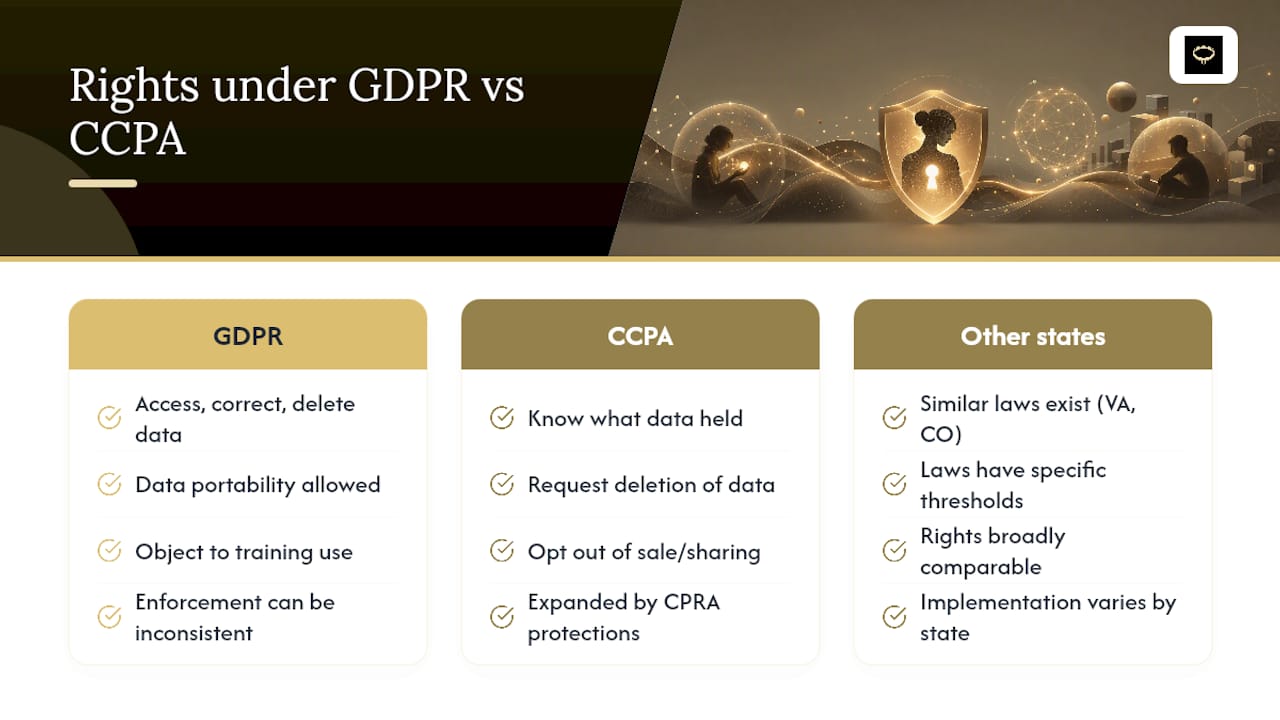
If you’re in the European Union or a country with equivalent protections, GDPR gives you the right to access, correct, and delete your personal data, including chat logs held by an AI sexting platform. You also have the right to data portability and the right to object to your conversations being used for model training, though enforcement against platforms operating outside the EU can be inconsistent.
The California Consumer Privacy Act, and its expansion under the California Privacy Rights Act, gives California residents a comparable set of rights: the ability to know what data a company holds, request deletion, and opt out of the sale or sharing of personal information. Several other states, including Virginia and Colorado, have passed similar consumer privacy laws with their own specific thresholds.
Here’s the practical catch: these rights only work if the platform is registered to comply and if you actually exercise them. A “right to delete” is meaningless if a platform ignores the request or if your data already left through a third-party API before you asked. Submit deletion and access requests in writing, keep a copy of the confirmation, and follow up if a platform doesn’t respond within the legally required window, generally 30 to 45 days depending on the law and jurisdiction. If a platform has no visible mechanism for exercising these rights at all, treat that absence itself as a warning sign about how seriously it takes them.
How Do You Vet a Platform’s Privacy Claims Before You Trust It?
Don’t take a privacy page at face value. Verify it the same way a security researcher would.
Start by searching the policy for three specific terms: “retention,” “training,” and “delete.” If a policy doesn’t specify a retention window in concrete days or months, that’s a gap, not an oversight. If it discusses training data use only in vague language about “improving our services,” assume your chats are fair game unless you find an explicit opt-out toggle in your account settings.
Ask whether the platform has published any independent audit or a technical whitepaper describing its encryption architecture. A real zero-knowledge or client-side encryption claim should be demonstrable, not just asserted. Industry reviewers have flagged that terms like “anonymous” and “no-log” are often unverifiable marketing claims rather than audited technical guarantees, so treat an unaudited claim with proportional skepticism.
Check the business model too. A platform that makes money from your subscription has less structural incentive to sell or repurpose your data than one running on ads or a free tier subsidized by data licensing. Finally, test the actual mechanics: create a low-stakes account, try the delete function, and see if support can answer specific questions about where data lives and who can access it. Vague answers from customer support are as telling as a vague policy.
What Happens Psychologically When AI Sexting Data Leaks?
A data breach involving AI sexting conversations carries a weight that a typical password leak doesn’t. These conversations often reveal fantasies, insecurities, and personal details that people share precisely because they believe the exchange is private and judgment-free. When that trust breaks, the fallout tends to be more personal and harder to recover from.
Victims of exposed intimate AI conversations report shame, anxiety, and fear of exposure to family, employers, or partners, even when the content itself was between a person and a chatbot rather than another human. Academic research on human-AI romantic relationships found that people tend to disclose more, and set fewer boundaries, the longer an intimate AI relationship continues, which means the psychological stakes of a breach often grow the longer someone uses a platform.
Sextortion built from leaked AI conversations or generated images adds a financial threat on top of the emotional one, and the social fallout, real or feared, can affect relationships, employment, and self-image well after the technical breach gets patched. This is one of the strongest arguments for choosing a platform with defensible architecture from the start rather than trying to repair trust after a leak. Prevention here isn’t just a technical preference. It’s the difference between a private hobby and a lasting personal crisis.
Get Privacy-First AI Intimacy With Mistrix
Everything covered above points to one conclusion: the platforms worth trusting are the ones built around consent and encryption from the ground up, not the ones bolting a privacy policy onto a generic chatbot after launch. Mistrix was designed around exactly that principle. Sensitive session data is encrypted client-side with a PIN only you hold, and every AI generation runs against your mandatory hard limits and safe word, so the guardrails you set actually govern the experience instead of sitting in fine print you never read.
If you’re the kind of user this guide was written for, someone who wants a personalized AI Domina, guided sessions, and a creative studio for custom images and scenes without handing over your most private conversations as training fodder. The platform uses a subscription model that generates revenue through user subscriptions rather than advertising or data brokerage. Explore the BDSM and fetish glossary to see the range of scenes and terminology the platform supports, then start with the free tier to test the onboarding flow, your hard limits, and your safe word before deciding whether Premium or Premium Plus fits how you want to use it.
Sources
- Be Careful What You Tell Your AI Chatbot | Stanford HAI
- AI girlfriend app leak exposes 400k users | Cybernews
- Privacy in human-AI romantic relationships (ACM)
- Policy/industry analysis on privacy claims (PMC)
- Practical guide and checklist for AI companions (Zenodo, 2025)
FAQ
Is AI sexting actually private?
No platform is automatically private. Privacy depends on the specific encryption architecture, retention policy, and training-use disclosures each platform publishes, so you have to verify claims rather than assume them.
Can AI sexting conversations be used to train models?
Yes, frequently by default. A Stanford HAI review found many leading AI companies feed conversations into training pipelines unless a user finds and activates an explicit opt-out.
What is the difference between encryption in transit and end-to-end encryption?
Encryption in transit protects your message while it travels to the server, but the company can still read it once it arrives. End-to-end or client-side encryption, like the PIN-based system Mistrix uses, means the server itself cannot access your plaintext content.
Can law enforcement access my AI sexting conversations?
Yes. A valid subpoena or civil discovery request can compel a platform to hand over stored chat logs and images, regardless of what its marketing promises about privacy.
What should I do if an AI companion app I use gets breached?
Change your password and account email immediately, revoke or replace any linked payment method, and contact the platform to find out exactly what data was exposed, then monitor for signs of sextortion or targeted harassment.