
AI can genuinely help with the emotional and mental side of BDSM aftercare, but it’s never a stand-in for physical medical care or crisis services. Safe use rests on three conditions: explicit consent baked into a pre-agreed protocol, real privacy protections like client-side PIN encryption, and a clear human escalation path when things go beyond what a chatbot can handle. Some AI companion platforms build toward exactly this, and the growing body of research on AI relational roles backs up why the guardrails matter.
TL;DR:
- AI can assist with emotional aftercare through check-ins, grounding prompts, and structured debriefs, but it cannot replace physical support or crisis intervention.
- Effective AI aftercare setup requires predefined safewords, clear boundaries, privacy controls, and an established escalation path to human support in emergencies.
- Privacy must be protected through client-side PIN encryption and short data retention, with transparent policies and user-controlled data management options.
- Relying on AI is unsafe when severe physical injury, suicidal ideation, or lasting dissociation occurs, requiring immediate human intervention and professional help.
- A comprehensive AI aftercare protocol includes immediate grounding, scheduled check-ins, debriefs, and follow-ups within the first 72 hours, tailored to the scene’s intensity.
Table of Contents
- What Is BDSM Aftercare, and Why Does It Matter?
- Can an AI Companion Actually Help With Aftercare?
- How Do You Set Up Consent-First AI Aftercare?
- What Privacy Features Should You Actually Demand?
- When Should You Stop Relying on AI and Call a Human?
- What Does a Starter AI Aftercare Protocol Look Like?
- Where MISTRIX.AI Fits Into a Consent-First Aftercare Plan
- Selected Research and Community Resources
- Sources
- FAQ
What Is BDSM Aftercare, and Why Does It Matter?
Aftercare is the deliberate physical and emotional care that follows a scene, designed to manage the neurochemical comedown your body goes through after intense play. You’ve probably felt it, or watched a partner feel it: the shaky hands, the sudden tears, the flat exhaustion that shows up an hour after everything wrapped. Community language calls this subdrop or domdrop; it hits both the submissive and dominant side of a scene, though it’s discussed far less for tops.
Good aftercare responds to that biology instead of ignoring it. The most common practices include:
- Hydration and warmth, since adrenaline and cortisol crashes often leave people cold and depleted
- Physical contact if wanted, from a blanket wrap to simple hand holding
- Verbal reassurance that names what happened and affirms it was consensual and good
- A debrief conversation about what worked, what didn’t, and what to adjust next time
- Extended check-ins that can run 24 to 72 hours after particularly intense scenes
Negotiate this before the scene starts, not during the drop. Trying to improvise aftercare while someone’s nervous system is scrambled is how good intentions turn into missed needs.
Can an AI Companion Actually Help With Aftercare?
Conversational AI shows up in aftercare in two distinct ways. As a relational partner, it’s the visible chat companion you talk to directly, working through the debrief or just sitting with you while the adrenaline fades. As a relational mediator, it works more quietly in the background, drafting a message to your partner, helping you organize your thoughts before a human conversation, or holding structure for a check-in schedule you set up in advance.
Research on conversational agents in intimate support points to a few real benefits: consistent check-ins that don’t depend on a partner’s schedule, grounding exercises you can run through at 3 a.m., structured debrief prompts that keep you from spiraling in your own head, and less isolation in the gaps between human contact.
There’s a real risk on the other side, though. Researchers describe an AI Amplifier Effect, where a companion’s language can intensify whatever emotional state you’re already in rather than settling it, according to the MIRA framework research on AI relational design. Other risks worth knowing:
- Emotional attachment that outpaces what the tool is built to hold
- Memory inconsistency across sessions that can feel like being forgotten
- Model updates or glitches that disrupt continuity right when you need stability
Pro Tip: Favor tools built with relational friction, meaning the AI occasionally checks whether it’s the right moment for reassurance versus redirection, rather than one that agrees with everything you say.
How Do You Set Up Consent-First AI Aftercare?
Treat this like negotiating a scene, because that’s exactly what it is. Here’s a checklist worth running through before you lean on any AI companion for aftercare:
- Register your safeword and hard limits before anything else, so the AI has boundaries baked in rather than guessed at.
- Complete a real onboarding flow, including a level-assessment quiz and a fetish-interest map, so the responses you get actually match your experience and interests.
- Set your aftercare timeline and preferred actions in advance: do you want check-ins every few hours, or one longer conversation the next day?
- Define exactly what the AI can remember, and confirm you can export or delete that data whenever you want.
- Decide on proactive outreach. Some people want the AI to reach out unprompted after a scene; others find that intrusive. Either is valid, but it should be your choice.
- Confirm there’s a human escalation path, meaning a defined trigger that hands you off to a real support contact if red flags appear.
- Check for session logs and a clear privacy policy before trusting the platform with anything sensitive.
Pro Tip: Revisit your hard limits and aftercare preferences every few months. What worked during your first scenes rarely stays static as you learn more about what you need.
What Privacy Features Should You Actually Demand?
Client-side PIN encryption means your sensitive data gets locked with a PIN only you hold, before it ever reaches a server. The platform is structurally unable to read your content, not just policy-bound not to.
Beyond encryption, a few concrete things separate a serious privacy setup from a marketing page:
- Short retention windows for sensitive session content, not indefinite storage by default
- Memory that’s opt-in, not opt-out buried in a settings menu
- One-click export and deletion, no support ticket required
- Clarity on whether deeper intimacy features sit behind a paywall, since monetized emotional dependency raises its own ethical questions worth thinking through
- A published privacy explanation you can actually read, not just a generic terms-of-service link
Verify these claims the same way you’d check any security tool: look for a specific privacy explanation rather than taking a tagline at face value.
When Should You Stop Relying on AI and Call a Human?
Some signs mean you need a person, not a chatbot, immediately. Watch for physical injury requiring medical attention, severe dissociation where you can’t orient to time or place, any suicidal ideation, or panic and depression that doesn’t lift after a day or two.
If you see any of these, act fast:
- Stop scene-related activity right away
- Call emergency services for physical harm, full stop
- Contact your predetermined emergency contact, the person you named in advance for exactly this situation
- Seek out a kink-aware clinician if distress lingers beyond a few days
Configure your AI companion to recognize these moments and hand off automatically. A single-button flow that notifies your pre-approved contact and exports a short, user-controlled session summary works better than hoping you’ll remember to reach out yourself mid-crisis, an approach detailed in Mistrix’s guide to hard limits.
What Does a Starter AI Aftercare Protocol Look Like?
Build this before your next scene, not after:
- 0 to 30 minutes: immediate grounding check-in. Simple prompts like “name three things you can feel right now” work well here.
- 2 to 4 hours: a soft check-in, just enough to confirm you’re stable and hydrated.
- 24 hours: a full debrief conversation covering what felt good, what didn’t, and any adjustments for next time.
- 72 hours: a follow-up for particularly intense scenes, since some drops take days to fully surface.
Register your safeword and memory scope explicitly before the scene: something like “Remember my safeword is [word]. Only recall aftercare preferences, not scene details, unless I say otherwise.” Then set your proactive outreach preference and confirm your human escalation contact inside the app’s settings, following the same setup logic laid out in Mistrix’s scene planning guide.
Where MISTRIX.AI Fits Into a Consent-First Aftercare Plan
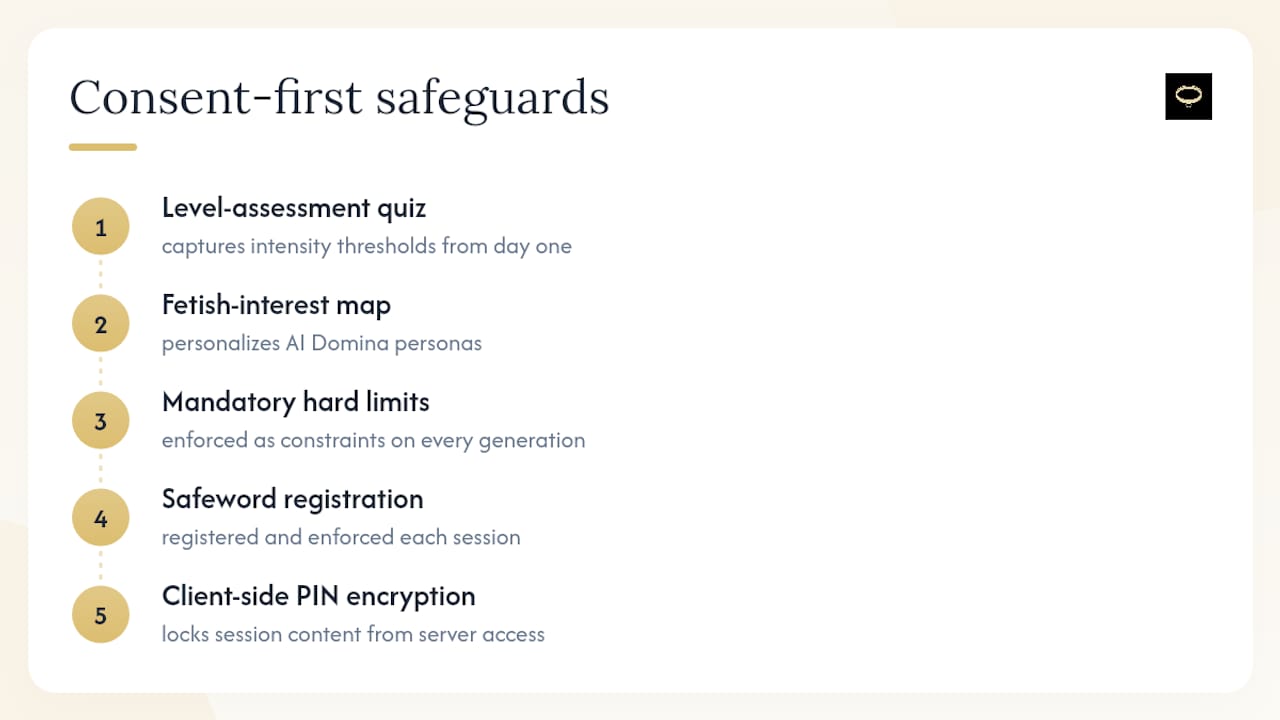
MISTRIX.AI is built around the checklist above, not adjacent to it. Onboarding includes a level-assessment quiz and a fetish-interest map, so your AI Domina understands your intensity thresholds from day one instead of guessing during a vulnerable moment. Mandatory hard limits and safeword registration are enforced as constraints on every generation, and all sensitive data gets locked with client-side PIN encryption that keeps your session content unreadable to the server itself.
If you’re weighing whether a companion app can actually hold your aftercare preferences instead of resetting every session, that persistent structure is the difference. You can browse the AI Domina personas to see how personalization shapes tone and pacing, or check the BDSM feature pages to see how hard limits translate into practice. Read the privacy documentation first if that’s your priority, then decide if a guided, consent-first setup is the aftercare partner you’ve been missing.
Selected Research and Community Resources
- Consent Culture: subdrop and domdrop signs
- Subtasks: BDSM aftercare guide
- PMC: conversational agents and intimate support
- ArXiv: AI Amplifier Effect and MIRA model
- Wikipedia: Aftercare (BDSM)
Sources
- Consent Culture, Recognizing signs of sub-drop/dom-drop
- Subtasks, BDSM aftercare guide
- PMC article on conversational agents and intimate support
FAQ
Can AI Replace a Human Partner for Aftercare?
No. AI can handle check-ins, grounding prompts, and debrief structure, but it can’t provide physical touch or replace a trained clinician when distress is severe or persistent.
How Long Should Aftercare Last After an Intense Scene?
Community guidance points to check-ins extending 24 to 72 hours after particularly intense play, with lighter follow-up continuing beyond that if needed.
What Makes an AI Companion Consent-First?
Look for mandatory hard limits, safeword registration during onboarding, opt-in memory controls, and a clear human escalation path, all features built into platforms like Mistrix.
Is My Data Actually Private on an AI Aftercare Companion?
Only if the platform uses genuine client-side PIN encryption, which keeps the server structurally unable to read your session content rather than just promising not to look.
Do Dominants Need Aftercare Too?
Yes. Domdrop is real and often underprepared for, and a solid protocol should include top-focused debrief and rest planning alongside submissive-focused care.